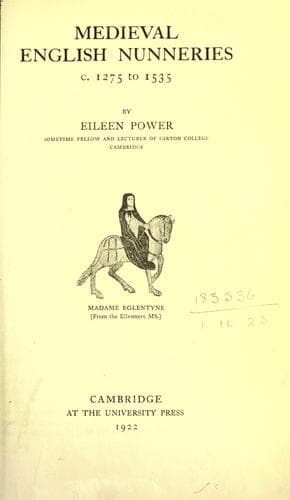
Medieval English Nunneries c. 1275 to 1535Power, Eileen
History
Medieval English Nunneries c. 1275 to 1535
Power, Eileen
Convents -- England; Monastic and religious life of women -- History
Whether girls were taught to write, as well as to read, is far more
doubtful. It is probable that the nuns did not always possess this
accomplishment themselves, nor did sober medieval opinion consider it
wholly desirable that girls should know how to write, on account both of
the general inferiority of their sex, and of a regrettable proclivity
towards clandestine love letters[898]. Still, writing may sometimes have
formed part of the curriculum; there is no evidence either way. For
drawing (by which presumably the art of illumination must be meant) there
is no warrant; a medieval nunnery was not a modern "finishing" school.
So much for what may be called book learning. Let us now examine for a
moment the other accomplishments with which nunnery-bred young ladies have
been credited. We may, as Mr Leach suggests, make a guess at spinning and
needlework, though here also there is no evidence for their being taught
to schoolgirls. Jane Scroupe, into whose mouth Skelton puts his "Phyllyp
Sparowe," was apparently being brought up at Carrow, and describes how she
sewed the dead bird's likeness on her sampler,
I toke my sampler ones,
Of purpose, for the nones,
To sowe with stytchis of sylke
My sparow whyte as mylke.
Confectionery does not seem very probable, for at this period the cooking
for the convent was nearly always done by a hired male cook and not (as
laid down in the Benedictine rule) by the nuns themselves, who were apt to
complain if they had to prepare the meals. For "home medicine" there is
absolutely no evidence, though all ladies of the day possessed some
knowledge of simples and herb-medicines and the girls may equally well
have learned it at home as among the nuns. It is probable that the
children learned to sing, if the nuns took them into the quire; but for
this there is no definite evidence, nor has any document been quoted to
prove that they learned to play upon instruments of music. It is true that
the flighty Dame Isabel Benet "did dance and play the lute" with the
friars of Northampton[899] and that "a pair of organs" occurs twice in
Dissolution inventories of nunneries[900], but an organ is hardly an
instrument of secular music to be played by the daughter of the house in a
manorial solar; and Dame Benet's escapade with the lute was a lapse from
the strict path of virtue. Finally to suggest that the nuns taught dances
verges upon absurdity. That they did sometimes dance is true, and grieved
their visitors were to hear it[901]; but what Alnwick would have said to
the suggestion that they solemnly engaged themselves to teach dancing to
their young pupils is an amusing subject for contemplation. Evidence for
everything except the prayers of the church and the art of reading is
non-existent; we can but base our opinion upon conjecture and probability;
and the probability for instrumental music is so slight as to be
non-existent. If it be argued that gentlewomen were expected to possess
Public-domain text, read in full here on John Shaqi.
Reviews
Reviews
No reviews yet
Be the first to share your thoughts on this work.
Elsewhere in the archive
Join the Discussion
Join the discussion
Sign in to leave a comment or review.
Sign InorCreate an account