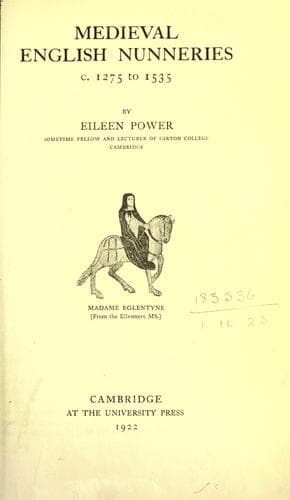
Medieval English Nunneries c. 1275 to 1535Power, Eileen
History
Medieval English Nunneries c. 1275 to 1535
Power, Eileen
Convents -- England; Monastic and religious life of women -- History
But it is necessary also to remember the other side of the picture.
Personal idiosyncrasies were no less apt to jar in the middle ages than
they are today; there are unfortunates who are born to be unpopular; there
are tempers which will lose themselves; and in conventual life there is no
balm of solitude for frayed nerves. These nuns were very human people; a
mere accident of birth had probably sent them to a convent rather than to
the care of husband and children in a manor-hall; just as in the
eighteenth and nineteenth centuries a mere accident of birth made one son
the squire, another the soldier and a third the parson. No special
saintliness of disposition was theirs and no miracle intervened to render
them immune from tantrums when they crossed the convent threshold. Nothing
is at once more striking and more natural than the prevalence of little
quarrels, sometimes growing into serious disputes, among the inmates of
monasteries. Browning's Spanish Cloister was no mere figment of his
inventive brain; indeed it is, if anything, less startling than the
medieval Langland's description of the convent, where Wrath was cook and
where all was far from "buxomnesse." Certainly Langland's indictment is a
violent one; the satirist must darken his colours to catch the eye; and,
had Chaucer been the painter, we might have had a dispute couched in more
courteous terms and more "estatlich of manere." But the satirist's account
is significant, because his very office demands that he shall exaggerate
only what exists; his words are a smoke which cannot rise without fire. So
Langland may speak through the lips of Wrath, with two white eyes:
I have an aunte to nonne . and an abbesse bothe,
Hir were leuere swowe or swelte . şan suffre any peyne.
I haue be cook in hir kichyne . and şe couent serued
Many monthes with hem . and with monkes bothe.
I was şe priouresses potagere . and other poure ladyes
And made hem ioutes of iangelynge . şat dame Iohanne was a bastard,
And dame Clarice a knightes doughter . ac a kokewolde was hire syre,
And dame Peronelle a prestes file . Priouresse worth she neuere
For she had childe in chirityme . all owre chapitere it wiste .
Of wycked wordes I, Wrath . here wortes imade,
Til "thow lixte" and "thow lixte" lopen oute at ones,
And eyther hitte other . vnder the cheke;
Hadde thei had knyves, by Cryst . her eyther had killed other[931].
From "thow lixte" to "Gr-r-r you swine" how little change!
Public-domain text, read in full here on John Shaqi.
Reviews
Reviews
No reviews yet
Be the first to share your thoughts on this work.
Elsewhere in the archive
Join the Discussion
Join the discussion
Sign in to leave a comment or review.
Sign InorCreate an account