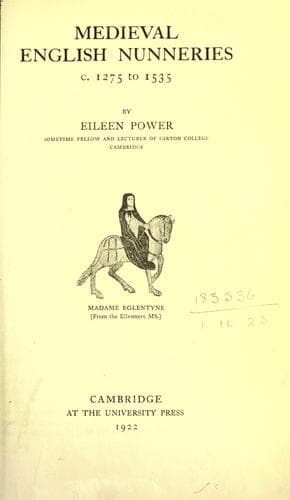
Medieval English Nunneries c. 1275 to 1535Power, Eileen
History
Medieval English Nunneries c. 1275 to 1535
Power, Eileen
Convents -- England; Monastic and religious life of women -- History
The words of Beatrix's maid in _Much Ado About Nothing_ spring to the
mind: "But methinks you look with your eyes as other women do." For three
weary centuries the bishops waged a holy war against fashion in the
cloister and waged it in vain, for as long as the nuns mingled freely with
secular women it was impossible to prevent them from adopting secular
modes. Occasionally a conscientious visitor found himself floundering
unhandily through something very like a complete catalogue of contemporary
fashions. So Bishop Longland at Elstow in 1531:
We ordeyne and by way of Iniuncon commande undre payne of disobedyence
from hensforth that no ladye ne any religious suster within the said
monasterye presume to were ther apparells upon ther hedes undre suche
lay fashion as they have now of late doon with cornered crests, nether
undre suche manour of hight shewing ther forhedes moore like lay
people than religious, butt that they use them without suche crestes
or secular fashions and off a lower sort and that ther vayle come as
lowe as ther yye ledes and soo contynually to use the same, unles itt
be at suche tymes as they shalbe occupied in eny handycrafte labour,
att whiche tymes itt shalbe lefull for them to turne upp the said
vayle for the tyme of suche occupacon. And undre like payne inoyne
that noon of the said religious susters doo use or were hereafter eny
such voyded shoys, nether crested as they have of late ther used, butt
that they be of suche honeste fashion as other religious places both
use and that ther gownes and kyrtells be closse afore and nott so depe
voyded at the breste and noo more to use rede stomachers but other
sadder colers in the same[944].
It is interesting to conjecture how the nuns obtained these gay garments
and ornaments. The growing custom of giving them a money allowance out of
which to dress themselves instead of providing them with clothes in kind
out of the common purse, certainly must have given opportunity for buying
the gilt pins, barred belts and slashed shoes which so horrified their
visitors. We know from Gilles li Muisis that Flemish nuns at least went
shopping[945]. But an even more likely source of supply lies, as we shall
see, in the legacies of clothes and ornaments, which were often left to
nuns by their relatives[946].
Public-domain text, read in full here on John Shaqi.
Reviews
Reviews
No reviews yet
Be the first to share your thoughts on this work.
Elsewhere in the archive
Join the Discussion
Join the discussion
Sign in to leave a comment or review.
Sign InorCreate an account