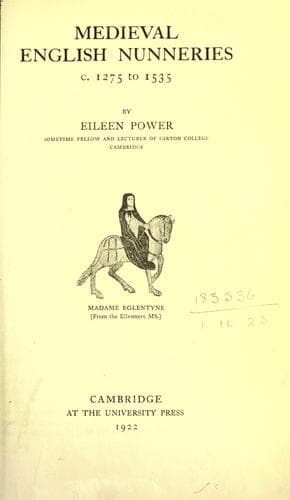
Medieval English Nunneries c. 1275 to 1535Power, Eileen
History
Medieval English Nunneries c. 1275 to 1535
Power, Eileen
Convents -- England; Monastic and religious life of women -- History
Not only in their clothes did medieval nuns seek to enliven existence
after the manner of their lay sisters. The bishops struggled long and
unsuccessfully against another custom of worldly women, the keeping of pet
animals[947]. Dogs were certainly the favourite pets. Cats are seldom
mentioned, though the three anchoresses of the _Ancren Riwle_ were
specially permitted to keep one[948], and Gyb, that "cat of carlyshe
kynde," which slew Philip Sparrow, apparently belonged to Carrow; perhaps
there was spread among the nunneries of England the grisly tradition of
the Prioress of Newington, who was smothered in bed by her cat[949].
Birds, from the larks of the Abbaye-aux-Dames at Caen, to the parrot
Vert-Vert at Nevers, are often mentioned[950]. Monkeys, squirrels and
rabbits were also kept. But dogs and puppies abounded. Partly because the
usages of society inevitably found their way into the aristocratic
convents, partly because human affections will find an outlet under the
most severe of rules:
(Objet permis a leur oisif amour,
Vert-Vert etait l'ame de ce sejour),
the nuns clung to their "smale houndes." Archbishop Peckham had to forbid
the Abbess of Romsey to keep monkeys or "a number of dogs" in her own
chamber and she was charged at the same time with stinting her nuns in
food; one can guess what became of the "rosted flesh or milk and
wastel-breed"[951]. At Chatteris and at Ickleton in 1345 the nuns were
forbidden to keep fowls, dogs or small birds within the precincts of the
convent or to bring them into church during divine service[952]. This
bringing of animals into church was a common custom in the middle ages,
when ladies often attended service with dog in lap and men with hawk on
wrist[953]; Lady Audley's twelve dogs, which so disturbed the nuns of
Langley, will be remembered[954]. Injunctions against the bringing of dogs
or puppies into choir by the nuns are also found at Keldholme and Rosedale
early in the fourteenth century[955]. But the most flagrant case of all is
Romsey, to which in 1387 William of Wykeham wrote as follows:
Public-domain text, read in full here on John Shaqi.
Reviews
Reviews
No reviews yet
Be the first to share your thoughts on this work.
Elsewhere in the archive
Join the Discussion
Join the discussion
Sign in to leave a comment or review.
Sign InorCreate an account