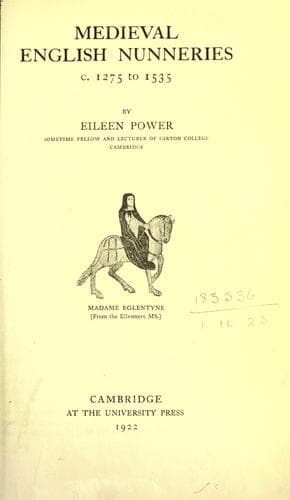
Medieval English Nunneries c. 1275 to 1535Power, Eileen
History
Medieval English Nunneries c. 1275 to 1535
Power, Eileen
Convents -- England; Monastic and religious life of women -- History
It is only necessary to compare these denunciations with such accounts of
the festivities in nunneries as have survived, to understand that the
revelling and disguising were less harmless than modern writers are apt to
represent them. Mr Leach attributes the schoolboys' feast to the fact that
regular holidays were unknown in the medieval curriculum and that the boys
found in the ribaldries of Childermastide some outlet for their long
suppressed spirits. Similarly the cramped and solemn existence led by the
nuns for the rest of the year probably made their one outbreak the more
violent. Nevertheless one cannot avoid feeling somewhat out of sympathy
with the bishops. "Dost thou think because thou art virtuous there shall
be no more cakes and ale?" Nuns were ever fond of ginger "hot i' the
mouth."
CHAPTER VIII
PRIVATE LIFE AND PRIVATE PROPERTY
All things are to be common to all.
_Rule of St Benedict_, ch. XXXIII.
The Rule of seint Maure or of seint Beneit,
Because that it was old and somdel streit
This ilke monk leet olde thinges pace
And held after the newe world the space.
CHAUCER, Prologue, ll. 173-6.
The reaction from a strict routine of life led monks and nuns to a more
serious modification of the Rule under which they lived than that
represented by pet dogs and pretty clothes, which were after all only
superficial frivolities. They sought also to modify two rules which were
fundamental to the Benedictine ideal. One was the rigidly communal life,
the obligation to do everything in company with everyone else. The other
was the obligation of strict personal poverty. A monastery was in its
essence a place where a number of persons lived a communal life, owning no
private property, but holding everything in the name of the community. The
normal routine of conventual life, as laid down in the Benedictine Rule,
secured this end. The inmates of a house spent almost the whole of their
time together. They prayed together in the choir, worked together in the
cloister, ate together in the frater, and slept together in the dorter.
Moreover the strictest regulations were made to prevent the vice of
private property, one of the most serious sins in the monastic calendar,
from making its appearance. All food was to be cooked in a common kitchen
and served in the common frater, in which no meat was allowed. All clothes
were to be provided out of the common goods of the house, and it was the
business of the chamberer or chambress to see to the buying of material,
the making of the clothes and their distribution to the religious; so
carefully was _proprietas_ guarded against, that all old clothes had to be
given back to the chambress, when the new ones were distributed. Above
all it was forbidden to monks and nuns to possess and spend money, save
what was delivered to them by the superior for their necessary expenses
upon a journey[989].
Public-domain text, read in full here on John Shaqi.
Reviews
Reviews
No reviews yet
Be the first to share your thoughts on this work.
Elsewhere in the archive
Join the Discussion
Join the discussion
Sign in to leave a comment or review.
Sign InorCreate an account