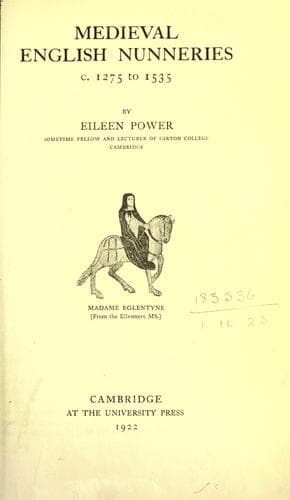
Medieval English Nunneries c. 1275 to 1535Power, Eileen
History
Medieval English Nunneries c. 1275 to 1535
Power, Eileen
Convents -- England; Monastic and religious life of women -- History
for the boys of the Almonry together with the boys of the chapel of St
Elizabeth, dressed up after the manner of girls, dancing, singing and
performing plays before the Abbess and nuns of St Mary's Abbey in
their hall on the Feast of Innocents[981];
and the account of Christian Bassett, Prioress of St Mary de Pre, contains
an item "paid for makyng of the dyner to the susters upon Childermasday
iij s iiij d, item paid for brede and ale for seint Nicholas clerks iij
d"[982]. The inventories of Cheshunt and Sheppey at the time of the
Dissolution contain further references to the custom and seem to show that
nunneries occasionally "ran" a St Nicholas Bishop of their own: at
Cheshunt there was found in the dorter "a chisell (chasuble) of white
ffustyan and a myter for a child bysshoppe at xx d"[983], and at Sheppey,
in a chapel, "ij olde myters for S. Nicholas of fustyan brodered"[984].
These childish festivities sound harmless and attractive enough, and
modern writers are sometimes apt to sentimentalise over their abolition by
Henry VIII[985]. But in this, as in his injunction of enclosure, Henry
was fully in accordance with the best ecclesiastical precedent. For the
Boy Bishop was originally a part of the Feast of Fools and the Feast of
Fools had an ancient and disreputable ancestry in the Roman Saturnalia. At
a very early date a regulation made to curtail such performances at St
Paul's declared that "what had been invented for the praise of sucklings
had been converted into a disgrace"[986]. In 1445, at Paris, it was stated
by the Faculty of Theology at the University that the performers
appeared in masks with the faces of monsters or in the dresses of
women, sang improper songs in the choir, ate fat pork on the horns of
the altar, close by the priest celebrating mass, played dice on the
altar, used stinking incense made of old shoes, and ran about the
choir leaping and shouting[987];
and about the same time the Synod of Basle had specifically denounced the
children's festival in hardly less violent terms as
that disgraceful, bad custom practised in some churches, by which on
certain high days during the year some with mitre, staff and
pontifical vestments like Bishops and others dressed as kings and
princes bless the people; the which festival in some places is called
the Feast of Fools or Innocents or Boys, and some making games with
masks and mummeries, others dances and breakdowns of males and
females, move people to look on with guffaws, while others make
drinkings and feasts there[988].
Public-domain text, read in full here on John Shaqi.
Reviews
Reviews
No reviews yet
Be the first to share your thoughts on this work.
Elsewhere in the archive
Join the Discussion
Join the discussion
Sign in to leave a comment or review.
Sign InorCreate an account