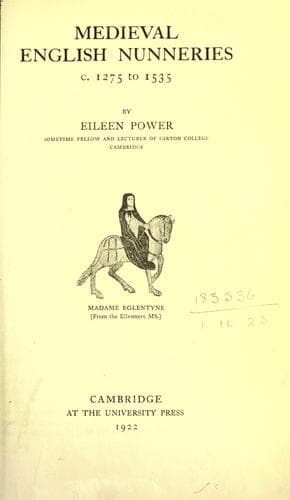
Medieval English Nunneries c. 1275 to 1535Power, Eileen
History
Medieval English Nunneries c. 1275 to 1535
Power, Eileen
Convents -- England; Monastic and religious life of women -- History
one; also she says that the nuns receive naught from the house but their
meat and drink and she herself keeps one household on her own account. At
Gracedieu the prioress deposed
that frater is not kept nor has it been kept for seven years and that
the nuns sit in company with secular folk at table in her hall every
day and that they have reading during meals; also she says there are
two households only in the house, to wit in her hall and the
infirmary, where there are three at table together;
here the prioress' hall simply took the place of the frater. There were
four households at Godstow and apparently several at Legbourne.
This division into households which messed separately went hand in hand
with another practice, which also softened the rigours of a strictly
communal life, to wit the allocation of separate rooms to certain nuns.
The obedientiaries of a house often had private offices, or _checkers_, in
which to transact their business, and the custom grew by which the head of
each _familia_ had her own room, in which her household dined. The
visitation reports continually refer to these private cells and to their
use as dining rooms and places of reception for visitors. Sometimes the
nuns even slept in them, though the dorter was always much more strictly
kept than the frater; at Godstow in 1432 for instance, Bishop Gray enjoins
"that the beds in the nuns' lodgings (_domicilia_) be altogether removed
from their chambers, save those for small children" (apparently their
pupils) "and that no nun receive any secular person for any recreation in
the nuns' chambers under pain of excommunication"[995]. Some light is
thrown upon these _camerae_ by the inventories of medieval nunneries. Thus
the inventory of the Benedictine Priory of Sheppey made at the Dissolution
describes the contents of "the greate chamber in the Dorter," which was
used as a treasury in which to keep the linen, vestments and plate of the
house, and in which one of the nuns Dame Agnes Davye seems to have slept;
there follows a description of the chambers of eight nuns, with the
furniture in each, from which it is clear that they had brought their own
furniture with them to the monastery. These "chambers" may have been
separate rooms or may have been partitions of the dorter, but if the
latter they were evidently so large as to be to all intents and purposes
separate rooms, for the furniture commonly includes painted cloth or paper
hangings for the room, a chest and a cupboard, besides the bed; in three
there is mention of windows and in two of fire irons. The most likely
conjecture is that the dorter was used as a treasury and bedroom for one
nun and the other chambers are separate rooms[996]. At some other houses
the dorter is mentioned but was clearly divided into separate cells by
wainscot partitions, and the wainscotting was sometimes sold at the
Dissolution[997].
Public-domain text, read in full here on John Shaqi.
Reviews
Reviews
No reviews yet
Be the first to share your thoughts on this work.
Elsewhere in the archive
Join the Discussion
Join the discussion
Sign in to leave a comment or review.
Sign InorCreate an account