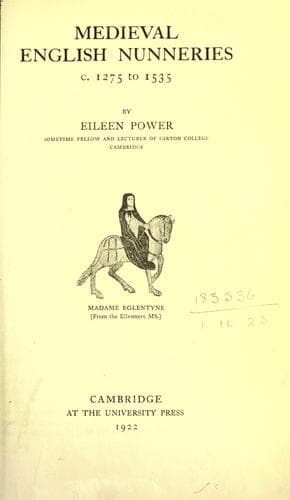
Medieval English Nunneries c. 1275 to 1535Power, Eileen
History
Medieval English Nunneries c. 1275 to 1535
Power, Eileen
Convents -- England; Monastic and religious life of women -- History
The attitude of ecclesiastical authorities to the modification of the
communal rule involved in _familiae_ and _camerae_ was, for various
reasons, one of strict disapproval. The custom of providing separate
messes was extremely uneconomical; the passing of much time in private
rooms was open to suspicion, especially when male visitors were received
there; communal life was an essential part of the monastic idea; finally
the amenities of private life were apt (as we shall see) to bring in their
train the amenities of private property. The policy of the bishops was,
for all these reasons, to restore communal life. They made general
injunctions that frater and dorter should duly be kept by all the nuns,
they made special injunctions for the abolition of separate households,
and above all they condemned private rooms:
"Also we enioyne yow, pryoresse," writes Alnwick to Catesby in 1442,
"that ye dispose so for your susters that the morne next aftere
Myghelmasse day next commyng wythe owten any lengare delaye, ye and
thai aftere yowre rewle lyfe in commune, etyng and drynkyng in oon
house, slepyng in oon house, prayng and sarufyng [serving] God in oon
oratorye, levyng vtterly all pryuate hydles [hiding-places], chaumbres
and syngulere housholdes, by the whiche hafe comen and growen grete
hurte and peryle of sowles and noyesfulle sklaundere of your
pryorye"[998].
But such injunctions were not easily enforced, and the politic bishops
sometimes tried to reduce rather than to abolish the households and
private rooms. It was often necessary--and indeed reasonable--to recognise
the three _familiae_ of the abbess' or prioress' lodgings, the
_misericord_ or infirmary and the frater[999]. Sometimes the bishops tried
to enforce the rule, laid down by the legate Ottobon (1268), to limit the
number who dined at the superior's table, viz. that at least two-thirds of
the convent were to eat each day in the frater[1000]. At Godstow Bishop
Gray, in 1432, allowed three households besides that of the frater[1001].
The condemnation of private rooms, and more especially of the reception of
visitors therein, was more severe; but here too, it was necessary in
large convents for the obedientiaries to have their offices, and other
individuals were sometimes given special permission to use separate
_camerae_. Some bishops allowed them to sick nuns, but others enforced the
use of the common infirmary[1002].
Public-domain text, read in full here on John Shaqi.
Reviews
Reviews
No reviews yet
Be the first to share your thoughts on this work.
Elsewhere in the archive
Join the Discussion
Join the discussion
Sign in to leave a comment or review.
Sign InorCreate an account