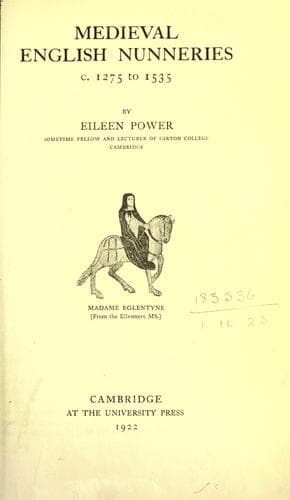
Medieval English Nunneries c. 1275 to 1535Power, Eileen
History
Medieval English Nunneries c. 1275 to 1535
Power, Eileen
Convents -- England; Monastic and religious life of women -- History
obvious departure from the Benedictine rule, which forbade the individual
disposal of property and made quite different arrangements for the
provision of clothing.
(2) Another class of payments made to individuals from the convent funds
was that of pittances. A pittance was originally an extra allowance of
food and it was quite common for a benefactor to leave money to a convent
for a pittance on the anniversary of his death. These pittances were,
however, sometimes paid in money and most account rolls will provide
examples of both. The nuns of Barking receive "Ruscheaw silver" as well
as the little pies called "risshowes" in Lent; the nuns of St Mary de Pre
(St Albans) had "Maundy silver" as well as ale and wine on Maundy
Thursday; the nuns of St Michael's Stamford receive their pittances
sometimes in money, sometimes in spices or pancakes, wine or beer. The
nuns of Romsey had a pittance of 6_d._ each on the feast of St Martin and
another of 6_d._ each "when blood is let"[1007].
(3) The third source from which nuns obtained private possessions lay in
the gifts, both in money and in kind bestowed upon them by their friends.
It has already been shown, in Chapter I, that there was a growing tendency
in the later middle ages for a nun to be supported by means of an annuity,
paid by her relatives and often ending with her life. The fact that these
annuities were ear-marked for the support of individuals must have
increased the temptation to regard them as the property of those
individuals, a temptation which was not present in the old days when an
aristocratic nun brought with her a grant of land to the house. One is
tempted to conjecture that individuals occasionally retained in their own
hands the expenditure of part at least of their annuities. Specific
information from English sources is unfortunately rare; but in the diocese
of Rouen in the middle of the thirteenth century Archbishop Eudes Rigaud
sometimes found it necessary to enjoin that certain nuns who possessed
rents which were reserved for their own use, should either transfer them
to the common funds, or else dispose of them only with the consent of the
prioress, a significant modification, which suggests that he was unable to
eradicate a deeply rooted custom, although it was strictly against the
rule[1008]. It was some twenty years later (c. 1277) that Bishop Thomas of
Cantilupe, writing to the nuns of Lymbrook, enjoined:
Let none of you keep in her own hand any possession or rent for
clothing and shoeing herself, even with the consent of the prioress,
albeit such possession or rent may be given to her by parents or
friends, because the goods of your community suffice not thereto; but
let it be given up wholly to your prioress, that out of it she may
minister to those to whom the gift was made, according to their needs;
otherwise they may easily fall into the sin of property and a secular
craving for gifts, thus rashly violating their vow[1009].
Public-domain text, read in full here on John Shaqi.
Reviews
Reviews
No reviews yet
Be the first to share your thoughts on this work.
Elsewhere in the archive
Join the Discussion
Join the discussion
Sign in to leave a comment or review.
Sign InorCreate an account