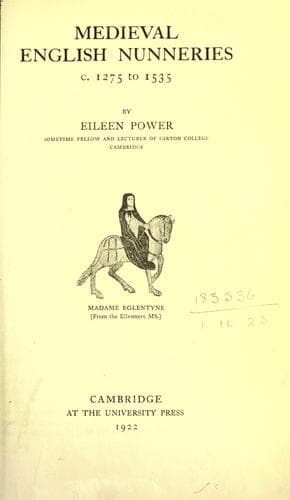
Medieval English Nunneries c. 1275 to 1535Power, Eileen
History
Medieval English Nunneries c. 1275 to 1535
Power, Eileen
Convents -- England; Monastic and religious life of women -- History
It has already been said that this approximation to private life was bound
to bring with it an approximation to private property and it remains now
to analyse the process by which these new methods of providing food, and
even more effectively, new methods of providing clothes, resulted in a
spread of _proprietas_, which was considered perfectly legitimate by the
nuns and within limits condoned by the bishops. The impression left upon
the mind by a study of monastic records during the last two centuries of
the middle ages is that in many houses the rule of strict personal poverty
was in practice almost completely abrogated, for it is quite obvious that
the nuns had the private and individual disposal of money and goods.
Indeed some convents seem almost like the inmates of a boarding house,
each of whom receives lodging and a certain minimum of food from the
house, but otherwise caters for herself out of her private income. This is
a considerable departure from the rule of St Benedict, and it is worth
while to analyse the sources from which the nuns drew the money and goods
of which they disposed. These sources may be classified under five
headings: (1) the annual allowance of pocket money (called _peculium_)
which was allowed to each nun from the funds of the house and out of which
she had to provide herself with clothes and other necessities; (2)
pittances in money; (3) gifts in money and kind from friends; (4)
legacies; (5) the proceeds of their own labour.
(1) The practice of giving a _peculium_ in money out of the common funds
of the house to monks and nuns began at quite an early date (it is
mentioned at the Council of Oxford in 1222) and was so much an established
custom in the fourteenth and fifteenth centuries that to withhold it was
considered by bishops a legitimate cause of complaint against superiors.
The amount of the _peculium_ varied at different houses. In the majority
of cases it was intended to be used for clothes and its payment is
sometimes entered in account rolls. At Gracedieu the nuns had "salaries"
of 6_s._ 8_d._ a year each for their vesture and the careful treasuress
enters all their names[1003]. At St Michael's, Stamford, a chambress'
account, which has been preserved among the treasuress' accounts, shows
that in 1408-9 the prioress was paid 5_s._ for her "camise" and all the
other eleven nuns 4_s._ each, while the two lay sisters had 3_s._
each[1004]. Similarly at St Radegund's, Cambridge, a certain pension from
St Clement's Church was ear-marked for the clothing of the nuns and was
paid over directly to them[1005]; and the Prioress of Catesby in 1414-5
includes under "customary payments" money paid "to the lady Prioress and
her six nuns and to one sister and her three brethren by the year for
clothing"[1006]. The fact that the _peculium_ was a payment made from the
common funds and not the privately owned income of an individual allowed
it to escape the charge of _proprietas_, but it was nevertheless an
Public-domain text, read in full here on John Shaqi.
Reviews
Reviews
No reviews yet
Be the first to share your thoughts on this work.
Elsewhere in the archive
Join the Discussion
Join the discussion
Sign in to leave a comment or review.
Sign InorCreate an account