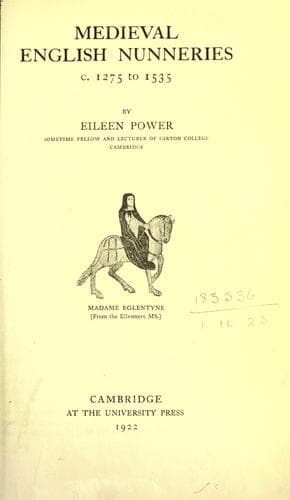
Medieval English Nunneries c. 1275 to 1535Power, Eileen
History
Medieval English Nunneries c. 1275 to 1535
Power, Eileen
Convents -- England; Monastic and religious life of women -- History
Possibly some of these splendid pieces of plate found their way to the
altar, and the cups and spoons to the frater of the house, but the nuns
undoubtedly sometimes kept them for private use in their own _camerae_.
Here also were kept the beds, such as that splendid one left by Bishop
Skirlaw to his sister, the "bed of Norfolk" which Sir Robert de Roos left
to his daughter Joan (1392)[1023], the "bed of worstede with sheets, which
she kindly gave me," left by William Felawe, clerk, to Katherine Slo,
Prioress of Shaftesbury (1411)[1024]. Doubtless Juliana de Crofton, nun
of Hampole, knew what use to make of "six shillings and eightpence and a
cloak lined with blue and two tablets and one saddle with a bridle and two
leather bowls"[1025]; here at one gift was the wherewithal for writing a
letter to announce a visit and for paying that visit on horseback, in gay
and unconventual attire. Indeed the constant legacies of clothes to nuns
go far to explain where it was that they obtained those cheerful secular
garments, against which their bishops waged war in vain. In days when
clothes were made of heavy and valuable stuffs and richly adorned, it was
a very common custom for a woman to divide up her wardrobe between
different legatees, and men also handed on their best garments. When in
1397 Margaret Fairfax is found using "divers furs and even gray fur
(_gris_)"[1026], one remembers, with a sudden flash of comprehension, the
"cloak of black cloth furred with gray" which her brother left her four
years earlier. What did Elizabeth de Newemarche, nun, do with the mantle
of brounemelly left her by Lady Isabel Fitzwilliam?[1027] What did Sir
William Bonevyll's sister at Wherwell do with "his best hoppelond with the
fur"?[1028] What above all did the Prioress of Swine do with all those
costly fur trimmings left her by the Bishop of Durham? Yorkshire nunneries
were apt to be undisciplined and worldly; great ladies there, if
Archbishop Melton is to be believed, sometimes considered that they might
dress according to their rank[1029]. We may safely guess that the Prioress
of Swine, like her contemporary at Nunmonkton, wore the furs; and
visitation records do not lead us to suppose that other nuns sold their
blue-lined cloaks and houppelonds for the sake of their convents, or
bestowed them on the poor.
Public-domain text, read in full here on John Shaqi.
Reviews
Reviews
No reviews yet
Be the first to share your thoughts on this work.
Elsewhere in the archive
Join the Discussion
Join the discussion
Sign in to leave a comment or review.
Sign InorCreate an account