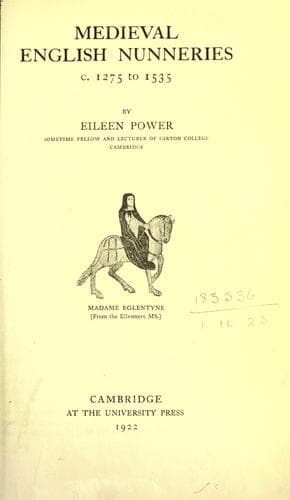
Medieval English Nunneries c. 1275 to 1535Power, Eileen
History
Medieval English Nunneries c. 1275 to 1535
Power, Eileen
Convents -- England; Monastic and religious life of women -- History
It is a common injunction that nuns are to wear no other ring than that
which, at their consecration, made them brides of Christ[1030]; but the
rule was often disobeyed and Dame Clemence Medforde's "golden rings
exceeding costly with divers precious stones"[1031] are explained when we
remember the "three gold rings, one having a sapphire, another an emerald
and the third a diamond" which the rich pepperer's widow left to Dame
Margaret Heyroun[1032]. Madame Eglentyne herself may have owed to one of
the many friends, who held her digne of reverence, her "peire of bedes,
gauded al with grene," of small coral. When Sir Thomas Cumberworth died in
1451 he ordered that "the prioris of Coton, of Irford, of Legburn and of
Grenefeld have Ilkon of yam a pare bedys of corall, as far as that I have
may laste, and after yiff yam gette [give them jet] bedes"[1033], and so
also Matilda Latymer left her daughter at Buckland a set of "Bedys de
corall"[1034] and Margerie de Crioll left a nun of Shaftesbury "my
paternoster of coral and white pearls, which the Countess of Pembroke gave
me"[1035].
(5) The fifth and last source from which nuns could derive a private
income was by the work of their own hands and brains. It has been stated
above that very little is known about the sale of fine needlework by nuns,
but a very interesting case at Easebourne seems to show that they
sometimes considered themselves entitled to retain for their own private
use the sums which they earned. In 1441 one of the complaints against the
gay prioress was that she "compels her sisters to work continually like
hired workwomen, and they receive nothing whatever for their own use from
their work, but the prioress takes the whole profit." The bishop's
injunction is extremely significant:
the prioress shall by no means compel her sisters to continual work of
their hands and if they should wish of their own accord to work, they
shall be free to do so, but yet so that they may reserve for
themselves the half part of what they gain by their hands; the other
part shall be converted to the advantage of the house and unburdening
it from debt[1036].
In fine, the Bishop is obliged to acquiesce in a serious breach of the
Benedictine rule: the plea of the nuns to commit the sin of _proprietas_
is considered as a reasonable demand; and the compromise that half their
earnings should go to the common fund is intended rather to check the
prioress than the nuns. From the injunctions of other bishops it would
appear that the private boarders and private pupils taken by individual
nuns sometimes paid their fees to those individuals and not to the
house[1037]; the "household" system made the reception of such boarders
easy.
Public-domain text, read in full here on John Shaqi.
Reviews
Reviews
No reviews yet
Be the first to share your thoughts on this work.
Elsewhere in the archive
Join the Discussion
Join the discussion
Sign in to leave a comment or review.
Sign InorCreate an account