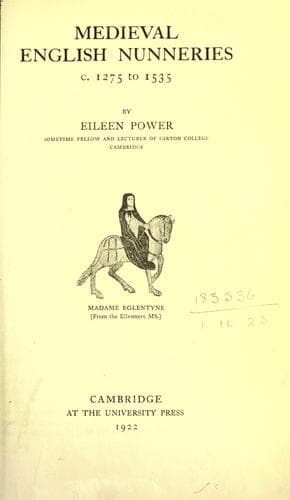
Medieval English Nunneries c. 1275 to 1535Power, Eileen
History
Medieval English Nunneries c. 1275 to 1535
Power, Eileen
Convents -- England; Monastic and religious life of women -- History
The next effort made in England to enforce enclosure upon nuns was the
result of Boniface VIII's Bull _Periculoso_. Bishops' registers about the
year 1300 sometimes contain copies of this severe enactment. One of the
earliest efforts to carry it out was made by Simon of Ghent, Bishop of
Salisbury, who on November 28th, 1299, issued a long letter to the Abbess
of Wilton (obviously inserted in the register as a specimen of a circular
sent to each nunnery in the diocese), embodying the text of the bull and
ordering her to put it into force, and in 1303 he issued a mandate for the
enclosure of the nuns of Shaftesbury, Wilton, Amesbury, Lacock, Tarrant
Keynes and Kington[1089]. The Register of Godfrey Giffard, Bishop of
Worcester, contains a note in the year 1300:
As to the shutting up of nuns. It is expedient that a letter of
warning be sent according to the form of the constitution and directed
to every house of nuns, that they do what is necessary for their
inclusion and cause themselves to be enclosed this side the Gule of
August.
The Bishop seems however from the beginning to have doubted his capacity
to carry out the decree, for further on the register contains another
note, "As to whether it is expedient to enclose the nuns of the diocese of
Worcester"[1090]. An undated note of _Inhibiciones facte monialibus de
Werewell_ in the Register of John of Pontoise, Bishop of Winchester, among
other documents belonging to 1299-1300, is probably in part a result of
_Periculoso_:
We forbid on pain of excommunication any nun or sister to go outside
the bounds of the monastery until we have made some ordinance
concerning enclosure. Item let no one be received as nun or sister
until we have enquired more fully into the resources of the house.
Item we order the abbess to remove all secular women and to receive
none henceforth as boarders in their house. Item let her permit no
secular clerk or layman to enter the cloister to speak with the
nuns[1091].
But the most detailed information as to the efforts of a conscientious
bishop to enforce Boniface VIII's decree in England is contained in the
Register of Bishop Dalderby of Lincoln. Dalderby was a new broom in the
diocese and he determined to sweep clean. On June 17th, 1300, he directed
a mandate to the archdeacons of his diocese ordering each to associate
with himself some other mature and honest man and to visit the religious
houses in his own archdeaconry, explaining the terms of the new bull
intelligibly to the nuns and ordering them to remain within their
nunneries and to permit no one to enter the precincts contrary to the
tenour of the decree, until the Bishop should be able to visit them in
person; the heads of the houses were to be specially warned to carry out
the decree and for better security a sealed copy of it was to be deposited
in each house by the commissioners[1092].
Public-domain text, read in full here on John Shaqi.
Reviews
Reviews
No reviews yet
Be the first to share your thoughts on this work.
Elsewhere in the archive
Join the Discussion
Join the discussion
Sign in to leave a comment or review.
Sign InorCreate an account