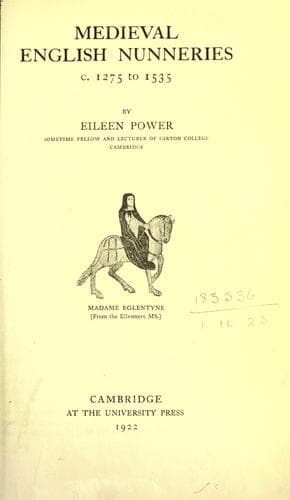
Medieval English Nunneries c. 1275 to 1535Power, Eileen
History
Medieval English Nunneries c. 1275 to 1535
Power, Eileen
Convents -- England; Monastic and religious life of women -- History
The Barking injunctions are slightly different and the first condition
imposed therein is interesting: "That they be sent forth only for a
necessary and inevitable cause, that is in particular the imminent death
of a parent, beyond which cause we can hardly imagine any other which
would be sufficient"[1084]. These injunctions are very severe, since they
limit the occasions upon which a nun might leave her convent to the
performance of some negotiation connected with the business of the house
and to attendance at the deathbeds of relatives and entirely forbid all
visits for pleasure to the houses of friends.
In 1281 Peckham published a mandate directed against the seducers of nuns;
after excommunicating all who committed or attempted to commit this crime
and declaring that absolution for the sentence could be given only by a
Bishop or by the Pope (except on the point of death), he proceeded to deal
with the question of the enclosure of nuns, on the ground that their
wandering in the world gave opportunity for such crimes, and sternly
forbade them to pay visits for the sake of recreation, even to the closest
relatives, or to remain out of their houses for more than two days on
business[1085]. The same year he also dealt with the subject in the course
of a set of constitutions, concerning various abuses, which he considered
to be in need of reform. The language of the chapter in which he treats of
the claustration of nuns is in parts the same as that of the ordinance
against seducers, but it is less severe, for it enacts only that nuns
shall not stay "more than three natural days for the sake of recreation,
or more than six days for any necessary reason, save in case of illness."
Moreover the Archbishop adds: "we do not extend this ordinance to those
who are obliged to beg necessities of life, while they are begging"[1086].
It was this modified version of his ordinance which he tried to impose in
his visitation of 1284, for at Romsey he recognised that the nuns might be
leaving the house for recreation and not merely upon the business of the
convent; the Abbess, for instance, is to take her three coadjutresses with
her when she goes out on business, and two of them if she go _causa
solatii_. At this house he forbade nuns to go out without a companion, or
to stay for more than three days with seculars and condemned their
practice of eating and drinking in the town: no nun, either on leaving or
returning to the convent, was to enter any house in the town of Romsey, or
to eat or drink there, and no cleric or secular man or woman was to give
them any food outside the precincts[1087]. At St Sepulchre (Canterbury)
Peckham regulated the visits of nuns to confessors outside the house, and
at Usk he ordered that no nun was to go out without suitable companions,
or to stay more than three or four days in the houses of secular
persons[1088].
Public-domain text, read in full here on John Shaqi.
Reviews
Reviews
No reviews yet
Be the first to share your thoughts on this work.
Elsewhere in the archive
Join the Discussion
Join the discussion
Sign in to leave a comment or review.
Sign InorCreate an account