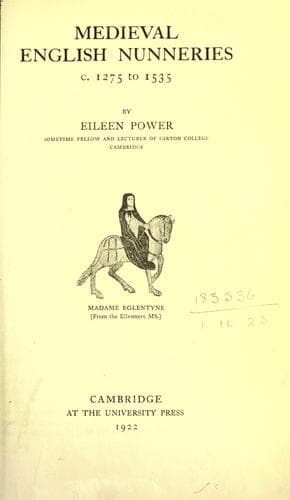
Medieval English Nunneries c. 1275 to 1535Power, Eileen
History
Medieval English Nunneries c. 1275 to 1535
Power, Eileen
Convents -- England; Monastic and religious life of women -- History
There was opposition at other convents, too, though we hear of no more
attacks on the episcopal shoulders. On August 19th Dalderby wrote as
follows to Master Benedict de Feriby, rector of Broughton, Northants (a
church in the presentation of the Abbess and Convent of Delapre):
It has come to our ears, by clamorous rumour, that some of the nuns of
our diocese, spurning good obedience, slackening the reins of honesty
and shamelessly casting aside the modesty of their sex, despise the
papal statute concerning enclosure directed to them, as well as our
injunctions made to them upon the subject, and frequent cities and
other public places outside their monasteries, and mingle in the
haunts of men;
he proceeded to order Feriby to visit nunneries wherever he considered it
expedient to do so, and to punish those who were guilty of breaking the
statute, signifying to the Bishop, by a certain date, the names of all
who had been accused of doing so, whether they had been found guilty or
not[1095]. This mandate is no doubt in part explained by two other letters
which he dispatched on the same day; one of them was directed to the
Archdeacon of Northampton and set forth (in language which often repeats
_verbatim_ the phrases of the papal bull) that at the Bishop's recent
visitation of Delapre (Northampton) he had found three nuns in apostasy,
having cast off their habits after being a long time professed, and left
their house to live a secular life in the world[1096]. The other letter
contains a sentence of the greater excommunication against a nun of
Sewardsley, for similar conduct[1097]. These cases of apostasy were less
rare than might be imagined; Dalderby had to deal with two others during
his episcopate, one at St Michael's, Stamford[1098], and the other at
Goring[1099]; and during the rule of his predecessor Sutton three nuns had
escaped from Godstow and one from Wothorpe[1100]. They illustrate the
undoubted truth that it was only the existence (already in the thirteenth
century) of very grave disorders, which led reformers like Ottobon,
Peckham and Boniface VIII to "beat the air" with such severe restrictions.
Public-domain text, read in full here on John Shaqi.
Reviews
Reviews
No reviews yet
Be the first to share your thoughts on this work.
Elsewhere in the archive
Join the Discussion
Join the discussion
Sign in to leave a comment or review.
Sign InorCreate an account