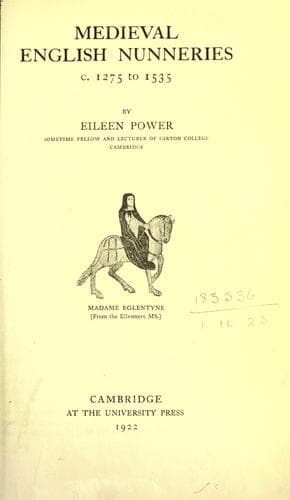
Medieval English Nunneries c. 1275 to 1535Power, Eileen
History
Medieval English Nunneries c. 1275 to 1535
Power, Eileen
Convents -- England; Monastic and religious life of women -- History
Margaret, they said, desired to lead a life of
less and not of more restraint and her real object was to join her sister,
who was at that time Prioress of Ivinghoe, if indeed her request were not
a mere pretext for apostasy; for
the said Margaret Crosse has caused and commanded certain goods,
property and jewels belonging to our priory to be stealthily conveyed
by certain of the said Margaret's friends in the flesh from our priory
to foreign and privy places, and to such conveyance done in her name
has lent her authority, with the purpose, as is strongly suspected, of
taking advantage of the darkness one night ... and transferring
herself utterly and entirely of her own motion to places wholly
strange, without having or asking and against our will[1132].
Moreover had the holy father considered the merits of their house and the
loss to it, if Margaret seceded?
Inasmuch as in our priory according to the observances of the rule God
is served and quire is ruled both in reading and singing and chanting
the psalms and toiling in the vineyard of the Lord of Sabaoth at the
canonical hours by day and night, while we also patiently endure
grievous cares, fastings and watchings and further are instant
together in contemplation, even as the holy Spirit designs to give us
His inspiration. And the said Margaret Crosse, who is sufficiently
trained in such regular observances and is very needful for the
service of God in our priory aforesaid, wherein such regular
observances and contemplations are not so fully kept as in our
aforesaid priory ... would give herself to secular business in all
matters, rather than to such contemplation or observance of the rule;
and thereout shall arise to us and our priory not only grievous ill
repute, but also no small loss, especially in that such chantings and
regular observances would in likelihood suffer damage by reason of the
said Margaret's absence[1133].
There is an air of verisimilitude about the injured convent's argument,
though the visitation report of 1440-1 does not show them as the strict
and pious community which they claim to be; but what came of the affair we
do not know.
Public-domain text, read in full here on John Shaqi.
Reviews
Reviews
No reviews yet
Be the first to share your thoughts on this work.
Elsewhere in the archive
Join the Discussion
Join the discussion
Sign in to leave a comment or review.
Sign InorCreate an account