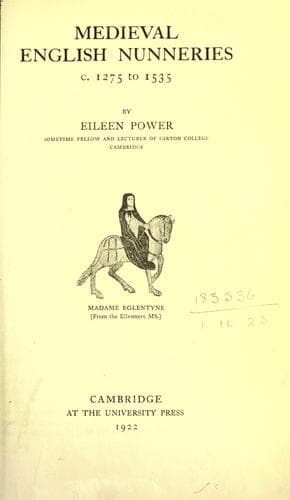
Medieval English Nunneries c. 1275 to 1535Power, Eileen
History
Medieval English Nunneries c. 1275 to 1535
Power, Eileen
Convents -- England; Monastic and religious life of women -- History
At this point, however, agreement ceased. The question of illness was
beset with difficulties. It was agreed that a nun might leave her house,
if she suffered from some contagious disease which threatened the health
of her sisters[1124], but opinions differed as to whether any relaxation
was to be allowed in less severe cases, when only her own health was in
question. The visitors sometimes issued licences for nuns to leave their
houses in order to recruit their health; thus in 1303 Josiana de Anelaby,
Prioress of Swine, had licence to absent herself from her house on account
of ill-health[1125], in 1314 Archbishop Greenfield licenced a nun of
Yedingham, who was suffering from dropsy, to visit friends and relatives
with honest company, for the sake of improving her health[1126] and in
1368 Joan Furmage, Abbess of Shaftesbury, actually received a dispensation
to leave the abbey for a year, and reside in her manors, for the sake of
air and recreation[1127]. It is significant that the _Novellae
Definitiones_ of the Cistercian Order in 1350 strictly forbade nuns to go
to the public baths outside their houses, which shows that they had been
in the habit of doing so[1128]. But strict reformers were always opposed
to such licences, and the specific prohibition of exeats for purposes of
cures and convalescences was common in the sixteenth and seventeenth
centuries, when the practice had become almost universal in France[1129].
Again there was some difference of opinion as to whether a nun might leave
her house, in order to enter one professing a stricter rule. Such a desire
was in theory laudable and by Innocent III's decretal _Licet_ the
principle was laid down that a bishop was bound _de jure_ to grant leave
for migration "sub praetextu majoris religionis et ut vitam ducant
arctiorem," as long as the motive of the petitioner was love of God and
not merely _temeritas_[1130]. But _temeritas_ was often to be suspected;
women, as St Francis de Sales complained, were full of whimsies[1131];
ennui, fancy, a craving for change, a friend in another house, might
masquerade as a desire to lead a stricter life elsewhere. Moreover a nun
who desired to remove herself was not unlikely to encounter opposition
from her own convent. An interesting case of such opposition occurred at
Gracedieu in 1447-8. Margaret Crosse, a nun of that house, desired to be
transferred to the Benedictine Priory of Ivinghoe "of a straiter order of
religion and observance, not for a frivolous or empty reason, but that she
may lead a life altogether and entirely harder." She obtained letters of
admission from the Prioress of Ivinghoe, but when she came to ask for
leave to migrate, the Prioress and Convent of Gracedieu refused to release
her from her obedience and confiscated the letters. Bishop Alnwick then
wrote to Gracedieu, requiring the Prioress either to let her go, or to
furnish him with a reason for their refusal. The Prioress and Convent
replied with some acerbity.
Public-domain text, read in full here on John Shaqi.
Reviews
Reviews
No reviews yet
Be the first to share your thoughts on this work.
Elsewhere in the archive
Join the Discussion
Join the discussion
Sign in to leave a comment or review.
Sign InorCreate an account