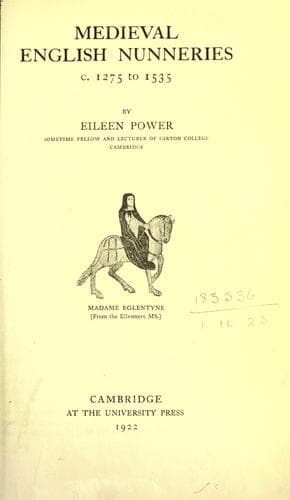
Medieval English Nunneries c. 1275 to 1535Power, Eileen
History
Medieval English Nunneries c. 1275 to 1535
Power, Eileen
Convents -- England; Monastic and religious life of women -- History
our tithes," at the heavy cost of 15_s._ 8_d._[1147] From Stamford to
London was a considerable journey, but the convent could not afford to
lose its tithes. The same business took Dame Katherine to the capital
another year; she hired three horses for six days and a serving man to go
with them and she took with her Dame Ida, in accordance with the
regulations; the whole cost of the expedition was L2. 11_s._, a very large
sum, and we will hope that the tithes brought in more than enough to cover
it[1148].
Sometimes, again, nuns left their houses to take part in ecclesiastical
ceremonies, such as processions. There does not seem much harm in the
whole convent sallying forth on these solemn occasions and indeed bishops
sometimes gave orders that they were to do so. In 1321 Rigaud de Asserio,
Bishop of Winchester, sent a letter to the Prior of St Swithun's monastery
"to pray for peace, with solemn processions"; he was to cause the Abbot
and Convent of Hyde, the Abbess and Convent of St Mary's, Winchester, and
all the other religious houses and parish priests of Winchester to come
together in the Cathedral and then to proceed in solemn procession through
the town[1149]. The strictest disciplinarians, however, looked with
suspicion even upon religious processions and sought to keep nuns within
the precincts of their cloister. Ottobon's Constitutions contain a proviso
that nuns are not to go out for public processions, but are to hold their
processions within the bounds of their own house[1150] and the prohibition
was repeated by Thomas of Cantilupe, Bishop of Hereford, writing to
Lymbrook in 1277[1151], and by William of Wykeham (who specifically based
his words upon Ottobon), writing to Romsey in 1387[1152]. A century later
the custom was forbidden in France at the provincial Council of Sens, in
1460 and again in 1485, where it was referred to as "a dangerous and evil
abuse"[1153]. Some explanation of this severity, which seems excessive,
may perhaps be gleaned from an injunction sent by Bishop Longland to
Elstow in 1531:
Moreover forasmoche as the ladye abbesse and covent of that house be
all oon religious bodye unite by the profession and rules of holy
sainct benedicte, and is nott conuenyent ne religious to be disseuerd
or separate, we will and Inioyne that frome hensforth noon of the said
abbesse seruauntes nor no ther secular person or persones, whatsoeuer
he or they be, goo in eny procession before the said abbesse betwene
hir and hir said covent, undre payne of exccommunycacon, and that the
ladye abbesse ne noon of hir successours hereafter be ladde by the
arme or otherwise in eny procession ther as in tymes paste hath been
used, undre the same payne[1154].
Public-domain text, read in full here on John Shaqi.
Reviews
Reviews
No reviews yet
Be the first to share your thoughts on this work.
Elsewhere in the archive
Join the Discussion
Join the discussion
Sign in to leave a comment or review.
Sign InorCreate an account