Medieval English Nunneries c. 1275 to 1535Power, Eileen
History
Medieval English Nunneries c. 1275 to 1535
Power, Eileen
Convents -- England; Monastic and religious life of women -- History
Attendance at religious processions and ceremonies might be, and
attendance at funerals undoubtedly was, regarded by the more moderate and
reasonable visitors as a legitimate reason for going outside the precincts
of the cloister. One other excuse of the same nature, however, sometimes
took a nun away from her convent for a considerable length of time and was
never looked upon with any favour by the authorities of the church. Yet it
is an excuse which we have the best of reasons for recognising, which is,
indeed, bound up with all that most people know of the medieval nun--for
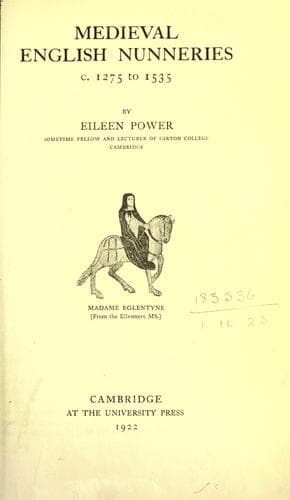
Chaucer has taught us that nuns were wont to go upon pilgrimages. All
pilgrimages did not, indeed, involve as long a journey as that taken by
Madame Eglentyne. The ladies of Nuncoton could make a pilgrimage to St
Hugh of Lincoln, without being away for more than a night and the ladies
of Blackborough would not have to follow for a long distance the milky way
to Walsingham[1160]. Nevertheless it is unnecessary to go further than
Chaucer to understand why it was that medieval bishops offered a strenuous
opposition to the practice; one has only to remember some of the folk in
whose company the Prioress travelled and some of the tales they told. If
one could be certain that she rode with her nun and her priests, or at
least between the Knight and the poor Parson! But there were also the
Miller and the Summoner and, worst of all, that cheerful and engaging
sinner the Wife of Bath. If one could be certain that she listened only to
the tale of Griselda, or of Palamon and Arcite, or yawned over Melibeus,
and that she fell discreetly to the rear when the company laughed over the
"nyce cas of Absalon and hende Nicholas"! If one could be certain that it
was to the Wife of Bath alone that the Merchant made his apology
Ladies, I prey yow that ye be nat wrooth;
I can nat glose, I am a rude man.
Certainly the Wife of Bath was a host in herself, but the plural is
ominous and the two nuns were the only other ladies in the company. The
sterner moralists of the middle ages bear out Chaucer's picture of a
typical pilgrimage with most unchaucerian denunciation[1161]. Pilgrims got
drunk at times, as drunk as the Miller, "so that vnnethe up-on his hors he
sat," on the very first day of the journey, as drunk as the "sory palled
gost" of a cook, when the cavalcade reached that
litel toun
Which that y-cleped is Bob-up-&-doun
Under the Blee in Canterbury weye.
Again, there are pilgrims, says Etienne de Bourbon, "who when they visit
holy places sing lecherous lays, whereby they inflame the hearts of such
as hear them and kindle the fire of lechery"; and like an echo rise the
well-known words:
Ful loude he song "Come hider, love, to me,"
This somnour bar to him a stif burdoun
Was never trompe of half so greet a soun,
Public-domain text, read in full here on John Shaqi.
Reviews
Reviews
No reviews yet
Be the first to share your thoughts on this work.
Elsewhere in the archive
Join the Discussion
Join the discussion
Sign in to leave a comment or review.
Sign InorCreate an account