Medieval English Nunneries c. 1275 to 1535Power, Eileen
History
Medieval English Nunneries c. 1275 to 1535
Power, Eileen
Convents -- England; Monastic and religious life of women -- History
and shrill and clear sound the miller's bagpipes, bringing the pilgrims
out of town[1162]. No place for a cloistered nun was the inn though one
feels that mine host's wife, "big in arme," would have kept the Tabard
respectable, whatever might be said of the Chequer-on-the-Hoop. No place
for her the road to Canterbury, nor yet Canterbury itself, where the monk
with the holy-water sprinkler was so anxious for a peep at her face and
where she hobnobbed over wine in the parlour, with the hostess and the
Wife of Bath[1163].
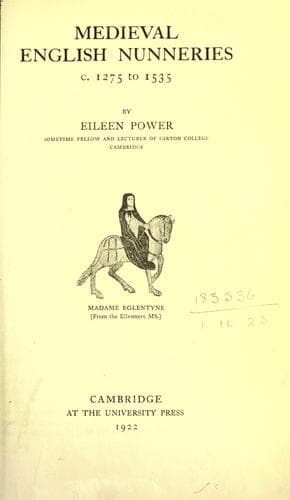
Madame Eglentyne, for all her simplicity, must have circumvented her
Bishop before she got there. For the Bishops were quite clear in their
minds that pilgrimages for nuns were to be discouraged. They were of
Langland's way of thinking:
Right so, if thow be religious, renne thow neuere ferther,
To Rome ne to Rochemadore, but as thi reule techeth,
And holde the vnder obedyence, that heigh wey is to heuene[1164].
As early as 791 the Council of Frejus had forbidden the practice[1165] and
in 1195 the Council of York decreed "In order that the opportunity of
wandering about may be taken from them [the nuns], we forbid them to take
the road of pilgrimage"[1166]. In 1318 Archbishop Melton strictly forbade
the nuns of Nunappleton to leave their house "by reason of any vow of
pilgrimage, which they might have taken; if any had taken such vows she
was to say as many psalters as it would have taken days to perform the
pilgrimage so rashly vowed"[1167]. One has a melancholy vision of Madame
Eglentyne saying psalters interminably through her "tretys" nose, instead
of jogging along so gaily with her motley companions and telling so
prettily her tale of little St Hugh. But the nuns of Nunappleton retained
their taste for pilgrimages and nearly two centuries later (in 1489) we
find Archbishop Rotherham admonishing their successors:
yat ye prioresse lycence none of your susters to goe pilgremage or
visit yer frendes w{t}oute a grete cause, and yen such a sister
lycencyate by you to have w{t} her oon of ye most sadd and well
disposid sistirs to she come home agayne[1168].
At Wix, twenty years later, the nuns were forbidden to undertake
pilgrimages without the consent of the diocesan[1169], and in 1531 Bishop
Longland wrote to the Prioress of Nuncoton:
Forasmoche as by your negligent sufferaunce dyuers of your susters
hath wandred a brode in the world, some under the pretence of
pylgrymage, some to see ther frends, and otherwise whereby hath growen
many Inconuenyences insolent behauiours and moche slaunder, as well to
your house as to those susters, as by the texts of my said visitation
doth euydently appere, I chardge you lady priores that from hensforthe
ye neyther licence ne suffre eny your susters to goo out of your
monastery,
Public-domain text, read in full here on John Shaqi.
Reviews
Reviews
No reviews yet
Be the first to share your thoughts on this work.
Elsewhere in the archive
Join the Discussion
Join the discussion
Sign in to leave a comment or review.
Sign InorCreate an account