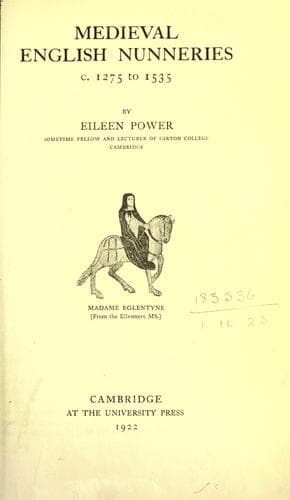
Medieval English Nunneries c. 1275 to 1535Power, Eileen
History
Medieval English Nunneries c. 1275 to 1535
Power, Eileen
Convents -- England; Monastic and religious life of women -- History
Excursions on convent business or for attendance at ecclesiastical
ceremonies (other than pilgrimages) were regarded as legitimate, though
strict disciplinarians sought to restrict them to occasions of real
urgency. But for the most part we hear about journeys undertaken for
pleasure and not for business, or at any rate the elastic term business is
stretched to cover some very pleasant wandering in the world and much
hobnobbing with friends. In spite of the Bull _Periculoso_[1174] bishops
were never able to prevent nuns from going to stay with their friends, and
sometimes the ladies made very long journeys for this purpose. Bishop
Stapeldon, for instance, ordained that when the nuns of Canonsleigh in
Devon went to visit their friends "in Somerset, Dorset, Devonshire or in
Cornwall" they might not stay for longer than a month; but if they went
outside these four counties the Abbess might allow them to stay longer
still, having regard to the distance of their destination and to the time
which would be spent in travelling[1175]. The bishops indeed were forced
to regard such visits as "reasonable occasions" for a breach of enclosure,
and their efforts, as has already been shown, were confined to regulating
rather than to stopping the practice; for the relatives of the nuns, as
well as the ladies themselves, would have been the first to resent any
interference with their visits. Whatever might be the theory of the Church
on the subject, blood was thicker than holy water; family affections and
family interests persisted in the cloister and the nun was welcomed at
many a hospitable board for her family's sake as well as for her own. All
this seems natural and obvious today and few would think the worse of the
nuns for their opposition to the stricter form of enclosure. Nevertheless
the authorities of the Church had reason for their distrust of these
absences from the convent. Once away from the cloister and staying in a
private house there was nothing to keep a nun from joining in the secular
revelries of friends, and though her behaviour might be exemplary the
convent rule aimed at keeping her unspotted even by temptation. An
anecdote related by Erasmus in his dialogue "Ichthyophagia" shows that the
danger of allowing nuns to visit their friends might be a real one. Two
nuns had gone to stay with their kinsfolk, and at supper
they began to grow merry with wine; they laughed and joked and kissed
and not over-modestly neither, till you could hardly hear what was
said for the noise they made.... After supper there was dancing and
singing of lascivious songs and such doings I am ashamed to speak of,
inasmuch as I am much afraid the night hardly passed very
honestly[1176].
Public-domain text, read in full here on John Shaqi.
Reviews
Reviews
No reviews yet
Be the first to share your thoughts on this work.
Elsewhere in the archive
Join the Discussion
Join the discussion
Sign in to leave a comment or review.
Sign InorCreate an account