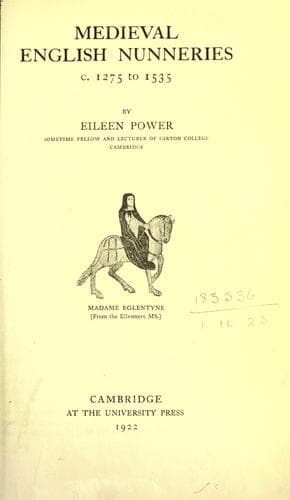
Medieval English Nunneries c. 1275 to 1535Power, Eileen
History
Medieval English Nunneries c. 1275 to 1535
Power, Eileen
Convents -- England; Monastic and religious life of women -- History
Again not only weddings, but also christenings, often involved unseemly
revels and this could not fail to affect nuns who, despite canonical
prohibition, were somewhat in demand as godmothers. Christening parties
were gay affairs; the gossips would return to the house of the child's
parents to eat, drink and make merry: "adtunc et ibidem immediate venerunt
in domam suam ad comedendum et bibendum et adtunc sibi revelaverunt de
baptismo"[1183]. If Antoine de la Sale's witty account of the "third joy
of marriage" has any truth[1184], and it is upheld by more sober
documents, bishops did well to mislike the christening parties for nuns;
Mrs Gamp was quite at home in the middle ages; she was probably a crony of
the Wife of Bath. It was in fact forbidden for monks and nuns to become
godparents, not only, as Mr Coulton has pointed out, "because this
involved them in a fresh spiritual relationship incompatible with their
ideal, but because it entangled them with worldly folk and worldly
affairs"[1185]. Thus in 1387 William of Wykeham wrote to the nuns of
Romsey: "We forbid you all and singly to presume to become godmothers to
any child, without obtaining our licence to do so, since from such
relationships expense is often entailed upon religious houses"[1186]. At
Nuncoton in 1440 two nuns asked that their sisters might be forbidden the
practice and Alnwick enjoined "that none of yowe have no children at the
fount ne confirmyng"[1187] and nearly a century later a similar injunction
was sent by Bishop Longland to Studley[1188].
There does indeed seem a certain incongruity in the presence of one who
had renounced the world at a wedding or a christening, even had such
ceremonies not been accompanied by very worldly revels. But they were less
incongruous than was the attendance of Mary, daughter of Edward I, the
nun-princess of Amesbury, upon her step-mother Queen Margaret and later
upon her niece Elizabeth de Burgh, during their confinements. A king's
daughter, however, could not be subjected to ordinary restraints; Mary led
a particularly free life, constantly visiting court and going on
pilgrimages, and there is no reason to suppose that ordinary nuns shared
her privileges[1189].
Public-domain text, read in full here on John Shaqi.
Reviews
Reviews
No reviews yet
Be the first to share your thoughts on this work.
Elsewhere in the archive
Join the Discussion
Join the discussion
Sign in to leave a comment or review.
Sign InorCreate an account