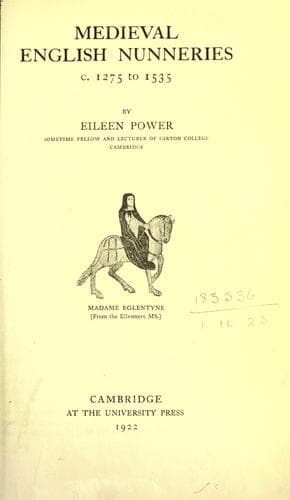
Medieval English Nunneries c. 1275 to 1535Power, Eileen
History
Medieval English Nunneries c. 1275 to 1535
Power, Eileen
Convents -- England; Monastic and religious life of women -- History
Two other nuns declared with great boldness "That my lord ded not
commaunde vs to tak my lady Snawe as priores, but he saide, 'Yf ye wyll
not take hir as priores I wyll make hir priores'" and that "they was wont
to have the priores chosyn by the Abbes and the convent, and not by my
lord, after seynte Bennet's rule," one of them remarking cryptically "that
she wyll take my lady Snawe as priores as other wyll doo" and not
otherwise. Meek little Dame Katherine Cornwallis was then interrogated and
said,
"that she was going forthe of the chapiter house wt. other of hir
susters and then when she herde my lady abbes commaund them to tary,
she ded tary behynde, but she sais that she thynks that none of the
oder susters that went forthe ded here hyr, but only she" (kind little
Dame Katherine), "and she is sory that tholde priores ys put out of
hir offes. She says that my lady abbes ded tare styll and domina
Alicia Boyfelde, domina Snawe, domina Katherina Wyngate, domina
Dorothia Commaforthe, domina Elizabethe Repton, and domina Elizabeth
Stanysmore."
Finally the ill-used abbess made her complaint; she had bidden saucy Dame
Alice Bowlis and others to stand up at matins, according to the custom of
the house, "and went out of hir stall to byde them soo doo, and lady
Bowlis ded make hir awnswer agene that, 'ye have mayde hir priores that
mayde ye abbes!', brekyng her silence ther." Evidently poor Elizabeth
Boifeld had not succeeded in living down the intrigues which had preceded
her election, and the convent suspected her of rewarding a supporter at
the expense of an old opponent.
Here was a pretty state of affairs in the home of buxomness and peace. But
the vicar-general acted firmly. Barbara Gray and Alice Bowlis were given a
penance for their disobedience; they were to keep silence; neither of them
was to come within "the howse calde the misericorde" (where meat was
allowed to be eaten), but they were always to have their meals in the
frater; neither of them was to write any letters; and they were to take
the lowest places of all among the sisters in "processions and in other
placys." Finally all the nuns were enjoined to be obedient to the abbess
and to the hated prioress. Their protests that they would never obey Dame
Alice Snawe, while the old prioress lived, were all in vain; and when some
ten years later the Reformation put an end to their dissensions by casting
them all upon the world, Dame Elizabeth Boyvill (_sic_), "abbesse,"
received an annual pension of L50, Dame Helen Snawe, "prioresse," one of
L4 and Dame Anne Wake, "prioresse quondam," one of 66_s._ 8_d._[165]
Public-domain text, read in full here on John Shaqi.
Reviews
Reviews
No reviews yet
Be the first to share your thoughts on this work.
Join the Discussion
Join the discussion
Sign in to leave a comment or review.
Sign InorCreate an account