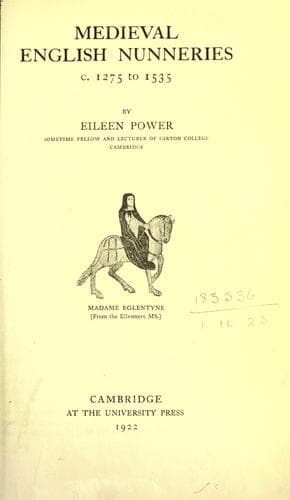
Medieval English Nunneries c. 1275 to 1535Power, Eileen
History
Medieval English Nunneries c. 1275 to 1535
Power, Eileen
Convents -- England; Monastic and religious life of women -- History
Much trouble might arise within a convent over the election of its head,
as these stories show. But sometimes external persons interfered; great
ladies used their influence and their wealth to secure the coveted post
for a protegee of their own; and the protegee herself was not averse to
oiling the palms of those in authority with good marks of silver;
"blood-abbesses," Ensfrid of Cologne would have called them ("that is,
foisted in by their kinsfolk") or "jester-abbesses" ("that is, such as had
been thrust in by the power of great folks") or "simoniacs, who had crept
in through money or through worldly services"[168]. In these cases there
was likely to be more trouble still, for great ladies were not always
careful of the character of a friend or relative whom they wished to
settle comfortably as head of a convent. In 1528 the Abbess of Wilton died
and Mr John Carey thought he would like the appointment for his sister
Eleanor, one of the nuns. He was brother-in-law to lovely Anne Boleyn, and
a word in her ear secured her warm support; the infatuated King wished to
please Anne; and Wolsey, steering his bark in troubled waters, wished to
please the King; so he promised that the lady should have the post, the
election to which had been placed in his hands by the nuns. It seemed that
all would go well with Dame Eleanor Carey, when Anne Boleyn pulled the
strings; but trouble arose, and the action taken by the Cardinal and by
the future oppressor of the monasteries is greatly to the credit of them
both, for both had much to lose from Anne. "As touching the matter of
Wilton" Henry wrote to her
My lord cardinal hath had the Nuns before him, and examined them, Mr.
Bell being present; which hath certified me, that for a truth that she
hath confessed herself, (which we would have had abbesse) to have had
two children by two sundry priests; and furder, since, hath been kept
by a servant of the Lord Broke, that was, and that not long ago;
wherefore I would not for all the gold in the world clog your
conscience nor mine to make her a ruler of a house, which is of so
ungudly demeanor, nor I trust you would not that neither for brother
nor sister I should so destain mine honor or conscience. And as
touching the prioress [Isabel Jordan] or Dame Eleanor's eldest sister,
though there is not any evident case proved against them, and that the
prioress is so old that of many years she could not be as she was
named [ill-famed]: yet notwithstanding to do you pleasure I have done
that neither of them shall have it, but that some other good and well
disposed woman shall have it, whereby the house shall be the better
reformed (whereof I ensure you it had much need) and God much the
better served[169].
Public-domain text, read in full here on John Shaqi.
Reviews
Reviews
No reviews yet
Be the first to share your thoughts on this work.
Join the Discussion
Join the discussion
Sign in to leave a comment or review.
Sign InorCreate an account