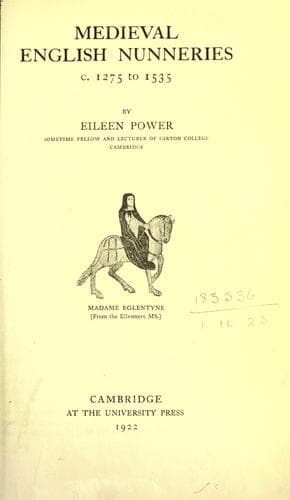
Medieval English Nunneries c. 1275 to 1535Power, Eileen
History
Medieval English Nunneries c. 1275 to 1535
Power, Eileen
Convents -- England; Monastic and religious life of women -- History
The stern reformer Peckham was forced to take in hand the conduct of the
Abbesses of Barking, Wherwell and Romsey, who were abusing their
independence of ordinary routine. The Abbess of Barking was forbidden to
remain in her private room after sunset, at which hour all doors were to
be locked and all strangers excluded; she might do so only very rarely, in
order to entertain distinguished guests or to transact important business;
and he ordered her to eat with the convent as often as possible,
"especially on solemn days" (i.e. great feasts)[182]. The Abbess of
Wherwell had apparently stinted her nuns in food and drink, but caused
magnificent feasts to be prepared for her in her own room, and Peckham
ordered that whenever there was a shortage of food in the convent, she was
to dine with the nuns, and no meal was to be laid in her chamber for
servants or strangers, but all visitors were to be entertained in the
exterior guest-hall; if at such times she were in ill health, and unable
to use the common diet, she might remain in her room, in the company of
one or two of the nuns. At times when there was no lack of food in the
convent and when she was entertaining guests in her own room, all
potations were to cease and all servants and visitors to depart at the
hour of compline[183]. About the same time (1284) Peckham wrote two
letters to the Abbess of Romsey, who had evidently been guilty of the same
behaviour. She was not to keep "a number of" dogs or monkeys, or more than
two maid servants, and she was not to fare splendidly in her own rooms
while the nuns went short; his injunctions to her are couched in almost
precisely the same language as those which he addressed to the Abbess of
Wherwell[184].
According to the Benedictine rule the superior, when not entertaining
guests, was permitted to invite the nuns in turn to dine with her in her
own room, for their recreation, and notices of this custom sometimes occur
in visitation reports; at Thicket (1309) the Prioress was enjoined to have
them one by one when she dined in her room[185]; at Elstow (1421-2) the
Abbess was to invite those nuns whom she knew to be specially in need of
refreshment[186]; at Gracedieu (1440-1) the Prioress was ordered
that ye do the fraytour be keppede daylye ... item that no mo of your
susters entende up on yowe, save onely your chapeleyn, and otherwhile,
as your rule wylle, ye calle to your refeccyone oon or two of your
susters to thair recreacyone[187];
Public-domain text, read in full here on John Shaqi.
Reviews
Reviews
No reviews yet
Be the first to share your thoughts on this work.
Join the Discussion
Join the discussion
Sign in to leave a comment or review.
Sign InorCreate an account