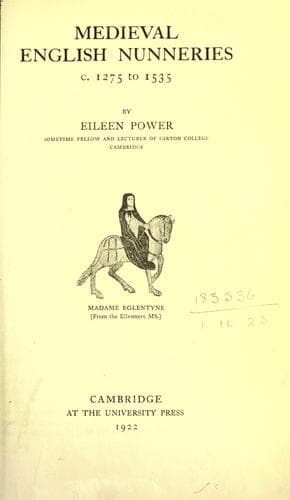
Medieval English Nunneries c. 1275 to 1535Power, Eileen
History
Medieval English Nunneries c. 1275 to 1535
Power, Eileen
Convents -- England; Monastic and religious life of women -- History
all cases, and politically when their houses were large and rich, abbots
and abbesses, priors and prioresses, ranked among the great folk of the
country side. They enjoyed the same prestige as the lords of the
neighbouring manors and some extra deference on account of their religion.
It was natural that the Prioress of a nunnery should be "holden digne of
reverence." The gentlemen whose estates adjoined her own sent their
daughters to her as novices, or (if her house were poor and the Bishop not
too strict) as school girls to receive their "nortelrye"; and they did not
themselves scorn the discreet entertainment of her guest-chamber and a
dinner of capons and wine and gossip at her hospitable board. The artisans
and labourers on her land lived by her patronage. All along the muddy
highroads the beggars coming to town passed word to each other that there
stood a nunnery in the meadows, where they might have scraps left over
from the convent meals and perhaps beer and a pair of shoes. The head of a
house, indeed, was an important person from many points of view, as a
neighbour, as a landlord and as a philanthropist.
The journeys which a prioress was sometimes obliged to take upon the
business of the convent offered many occasions of social intercourse with
her neighbours. It is, indeed, striking how great a freedom of movement
was enjoyed by these cloistered women. There are constant references to
journeys in account rolls. When Dame Christian Bassett, Prioress of St
Mary de Pre, rode to London for the suit against her predecessor in the
Common Pleas, she was accompanied on one occasion by her priest, a woman
and two men; on two other occasions she took four men; and during the
whole time that the suit dragged on, she was continually riding about to
take counsel with great men or with lawyers and journeying to and fro
between St Albans and London. On another occasion the account notes a
payment
in expenses for the prioresse and the steward with their servants and
for hors hyre and for the wages of them that wente to kepe the courte
wyth the prioresse atte Wynge atte two tymes xvj_s_ v_d_, whereof the
stewards fee was that of vj_s_ viij_d_; item paid to the fermour of
Wynge for his expenss ix_d_[214].
Public-domain text, read in full here on John Shaqi.
Reviews
Reviews
No reviews yet
Be the first to share your thoughts on this work.
Elsewhere in the archive
Join the Discussion
Join the discussion
Sign in to leave a comment or review.
Sign InorCreate an account