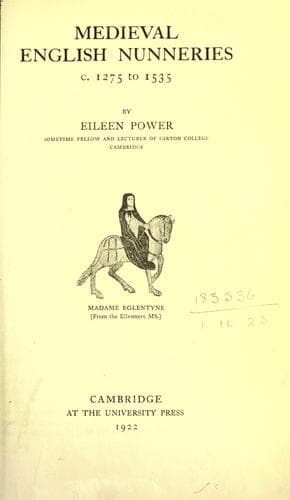
Medieval English Nunneries c. 1275 to 1535Power, Eileen
History
Medieval English Nunneries c. 1275 to 1535
Power, Eileen
Convents -- England; Monastic and religious life of women -- History
But sikerly she hadde a fair forheed;
It was almost a spanne brood, I trowe;
For, hardily, she was nat undergrowe.
Ful fetis was her cloke, as I was war.
Of smale coral aboute hir arm she bar
A peire of bedes, gauded al with grene;
And ther-on heng a broche of gold ful shene,
On which ther was first write a crowned A
And after, _Amor vincit omnia_.
Margaret Fairfax of Nunmonkton (1397) and the lady (her name is unknown)
who ruled Easebourne in 1441 are other examples of worldly prioresses;
they clearly regarded themselves as the great ladies they were by birth,
and behaved like all the other great ladies of the neighbourhood. Margaret
Fairfax used divers furs, including even the costly grey fur (gris)--the
same with which the sleeves of Chaucer's monk were "purfiled at the hond";
she wore silken veils and "she frequently kept company with John Munkton
and invited him to feasts in her room ... and John Munkton (by whom the
convent had for long been scandalised) frequently played at tables" (the
fashionable game for ladies, a kind of backgammon) "with the Prioress in
her room and served her with drink." No wonder she had to sell timber in
order to procure money[232]. The Prioress of Easebourne was even more
frivolous; the nuns complained that the house was in debt to the amount of
L40 and this principally owing to her costly expenses:
because she frequently rides abroad and pretends that she does so on
the common business of the house, although it is not so, with a train
of attendants much too large, and tarries long abroad, and she feasts
sumptuously both when abroad and at home, and she is very choice in
her dress, so that the fur trimmings of her mantle are worth a hundred
shillings,
as great a scandal as Clemence Medforde's cloth of Rennes at sixteen pence
the ell. The Bishop took strong measures to deal with this worldly lady;
she was deposed from all administration of the temporal goods of the
priory, which administration was committed to "Master Thomas Boleyn and
John Lylis, Esquire, until and so long as when the aforesaid house or
priory shall be freed from debt." It was also ordered
Public-domain text, read in full here on John Shaqi.
Reviews
Reviews
No reviews yet
Be the first to share your thoughts on this work.
Elsewhere in the archive
Join the Discussion
Join the discussion
Sign in to leave a comment or review.
Sign InorCreate an account