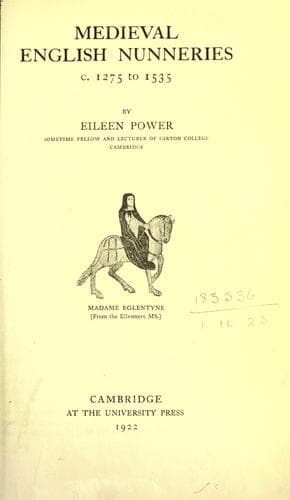
Medieval English Nunneries c. 1275 to 1535Power, Eileen
History
Medieval English Nunneries c. 1275 to 1535
Power, Eileen
Convents -- England; Monastic and religious life of women -- History
that the Prioress with all possible speed shall diminish her excessive
household and shall only retain, by the advice and with the assent of
the said John and Thomas, a household such as is merely necessary and
not more. Also that the Prioress shall convert the fur trimmings,
superfluous to her condition and very costly, to the discharge of the
debts of the house. Also that if eventually it shall seem expedient to
the said Masters Thomas and John at any time, that the Prioress should
ride in person for the common business of the house, on such occasions
she shall not make a lengthened stay abroad, nor shall she in the
interval incur expenses in any way costly beyond what is needful, and
thus when despatched to go abroad she must and ought rightly to
content herself with four horses only;
and those perhaps "bothe foul and lene," like the jade ridden by the
Nonnes Preeste when Chaucer met him on the Canterbury road[233].
The charge of gadding about the country side, sometimes (as in the
Prioress of Easebourne's case) with a retinue which better beseemed the
worldly rank they had abjured, was one not infrequently made against the
heads of nunneries[234]. The Prioress of Stixwould was accused, in 1519,
of spending the night too often outside the cloister with her secular
friends and the Bishop ordered that in future she should sleep within the
monastery, but might keep a private house in the precincts, for her
greater refreshment and for receiving visitors[235]. The Prioress of
Wroxall was ordered to stay more at home in 1323[236], and in 1303 Bishop
Dalderby even found that the Prioress of Greenfield had been absent from
her house for two years[237]. Even more frequent was the charge that
abbesses and prioresses repaid too lavishly the hospitality which they
doubtless received at neighbouring manors. Many abbesses gave that
"dyscrete enterteynement," which Henry VIII's commissioners so much
admired at Catesby[238]; but others entertained too often and too well, in
the opinion of their nuns; moreover family affection sometimes led them to
make provision for their kinsfolk at the cost of the house. In 1441 one of
the nuns of Legbourne deposed that many kinsmen of the prioress had
frequent access to the house, though she did not know whether it was
financially burdened by their visits; Alnwick ordered
that ye susteyn none of your kynne or allyaunce wythe the commune
godes of the house, wythe owten the hole assent of the more hole parte
of the couent, ne that ye suffre your saide kynne or allyaunce hafe
suche accesse to your place, where thurghe the howse shall be
chargeede[239].
Public-domain text, read in full here on John Shaqi.
Reviews
Reviews
No reviews yet
Be the first to share your thoughts on this work.
Elsewhere in the archive
Join the Discussion
Join the discussion
Sign in to leave a comment or review.
Sign InorCreate an account