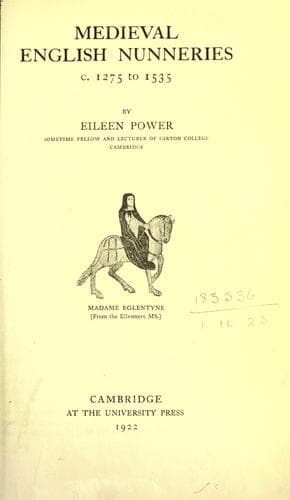
Medieval English Nunneries c. 1275 to 1535Power, Eileen
History
Medieval English Nunneries c. 1275 to 1535
Power, Eileen
Convents -- England; Monastic and religious life of women -- History
In the twenty-fourth year of her reign Joan Wiggenhall saw the last stone
laid in its place and the last plank nailed. The future was hid from her
happy eyes; she could not foresee the day, scarcely a century later, when
the walls she had reared so carefully should stand empty and forlorn, and
the molten lead of the roof should be sold by impious men. She must have
said with Solomon, as she looked upon her great church, "I have surely
built thee an house to dwell in, a settled place for thee to abide in for
ever"; and no flash of tragic prescience showed her the sheep feeding
peacefully over the spot where its "heyned stepul" pointed to the sky. In
1451 she departed to the heaven she knew best, a house of many mansions;
and her nuns, who for four and twenty years had lived a proud but
uncomfortable life in clouds of sawdust and unending noise, buried her
(one hopes) under a seemly brass in her church.
The mind preserves a pleasant picture of Euphemia of Wherwell and of Joan
Wiggenhall, when Margaret Wavere, Eleanor of Arden, Isabel Hermyte and the
rest are only dark memories, not willingly recalled. Which is as it should
be. The typical prioress of the middle ages, however, was neither Euphemia
nor Margaret. As one sees her, after wading through some hundred and fifty
visitation reports or injunctions, she was a well-meaning lady, doing her
best to make two ends of an inadequate income meet, but not always
provident; ready for a round sum in hand to make leases, sell corrodies,
cut down woods and to burden her successor as her predecessor had burdened
her. She found it difficult to carry out the democratic ideal of convent
life in consulting her sisters upon matters of business; she knew, like
all rulers, the temptation to be an autocrat; it was so much quicker and
easier to do things herself: "What, shulde the yong nunnes gyfe voices?
Tushe, they shulde not gyfe voices!" So she kept the common seal and
hardly ever rendered an account. She found that her position gave her the
opportunity to escape sometimes from that common life, which is so trying
to the temper; and she did not always keep the dorter and the frater as
she should. She was rarely vicious, but nearly always worldly; she could
not resist silks and furs, little dogs such as the ladies who came to stay
in her guest-room cherished, and frequent visits to her friends. When she
was a strong character the condition of her house bore witness, for good
or evil, to her strength; when she was weak disorder was sure to follow.
Very often she won a contented "omnia bene" from her nuns, when the Bishop
came; at other times, she said that they were disobedient and they said
that she was harsh, or impotent, or addicted to favourites. In the end it
is to Chaucer that we turn for her picture; as the Bishops found her, so
he saw her, aristocratic, tender-hearted, worldly, taking pains to
"countrefete chere of court," smiling "ful simple and coy" above her
Public-domain text, read in full here on John Shaqi.
Reviews
Reviews
No reviews yet
Be the first to share your thoughts on this work.
Elsewhere in the archive
Join the Discussion
Join the discussion
Sign in to leave a comment or review.
Sign InorCreate an account