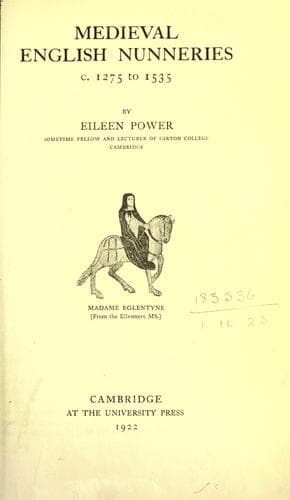
Medieval English Nunneries c. 1275 to 1535Power, Eileen
History
Medieval English Nunneries c. 1275 to 1535
Power, Eileen
Convents -- England; Monastic and religious life of women -- History
well-pinched wimple; a lady of importance, attended by a nun and three
priests, spoken to with respect and reverence by the not too mealy-mouthed
host (no "by Corpus Dominus," or "cokkes bones," or "tel on a devel wey!"
for her, but "cometh neer my lady prioresse," and "my lady prioresse, by
your leve"); clearly enjoying a night at the Tabard and some unseemly
stories on the road (though her own tale was exquisite and fitting to her
state). Religious? perhaps; but save for her singing the divine service
"entuned in her nose ful semely" and for her lovely address to the Virgin,
Chaucer can find but little to say on the point:
But for to speken of hir conscience
She was so charitable and so pitous--
that she would weep over a mouse in a trap or a beaten puppy! For charity
and pity we must go to the poor Parson, not to friar or monk or nun. A
good ruler of her house? doubtless; but when Chaucer met her the house was
ruling itself somewhere at the "shires ende." The world was full of fish
out of water in the fourteenth century, and, by seynt Loy, Madame
Eglentyne (like Dan Piers) held a certain famous text "nat worth an
oistre." So we take our leave of her--characteristically, on the road to
Canterbury.
CHAPTER III
WORLDLY GOODS
Tomorrows shall be as yesterdays;
And so for ever! saints enough
Has Holy Church for priests to praise;
But the chief of saints for workday stuff
Afield or at board is good Saint Use,
Withal his service is rank and rough;
Nor hath he altar nor altar-dues,
Nor boy with bell, nor psalmodies,
Nor folk on benches, nor family pews.
MAURICE HEWLETT, _The Song of the Plow_.
In many ways the most valuable general account of monastic property at the
close of the middle ages is to be found in the great _Valor
Ecclesiasticus_, a survey of all the property of the church, compiled in
1535 for the assessment of the tenth lately appropriated by the King[264].
It is true that only 100 out of the 126 nunneries then in existence are
described with any detail and that the amount of detail given varies very
much for different localities. Nevertheless the record is of the highest
importance, for in order to assess the tax the gross income of each house
is given (often with the sources from which it is drawn, classified as
temporalities and spiritualities) and the net income, on which the tenth
was assessed, is obtained by subtracting from the gross income all the
necessary charges upon the house, payments of synodals and procurations,
rents due to superior lords, alms and obits which had to be maintained
under the will of benefactors, and the fees of the regular receivers,
bailiffs, auditors and stewards.
Public-domain text, read in full here on John Shaqi.
Reviews
Reviews
No reviews yet
Be the first to share your thoughts on this work.
Elsewhere in the archive
Join the Discussion
Join the discussion
Sign in to leave a comment or review.
Sign InorCreate an account