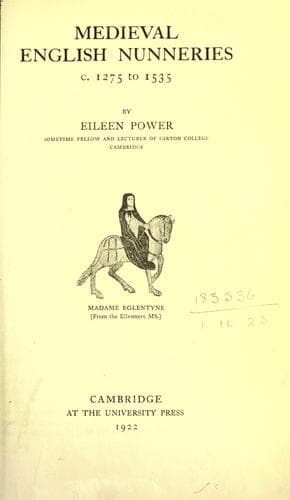
Medieval English Nunneries c. 1275 to 1535Power, Eileen
History
Medieval English Nunneries c. 1275 to 1535
Power, Eileen
Convents -- England; Monastic and religious life of women -- History
larderer to be salted; in summer time, when the convent could enjoy fresh
meat, five calves, fourteen sheep, ten hogs and twelve pigs were sent in
to the kitchen; and twenty cows were divided between the larder and the
kitchen, to provide salt and fresh beef. There is unfortunately no record
of the produce of the dairy, which supplied the convent with milk, cheese,
eggs and occasional chickens.
But the home-farm served the purpose of providing money as well as food.
The hides of the oxen and the "wool pells" of the sheep, which had been
killed for food or had fallen victim to that curse of medieval farming,
the murrain, were by no means wasted. Five hides belonging to animals
which had died of murrain were tanned and used for collars and other cart
gear on the farm; but all the rest were sold, thirty-six of them in all.
Most lucrative of all, however, was the sale of wool pells and wool, and
Dame Elizabeth Swynford is very exact; eighteen wool pells, from sheep
which the convent had eaten as mutton, sold before shearing for 35_s._
10_d._, thirty-eight sold after shearing for 9_s._ 6_d._, thirty-six lamb
skins for 1_s._; and 6_d._ was received "for wynter lokes sold." Moreover
the convent also sold one sack and eight weight of wool at L5. 4_s._ the
sack, for a total of L6. 16_s._ Altogether the "issues of the manor"
amounted to the substantial sum of L24. 8_s._ 8_d._, chiefly derived from
these sales of wool and wool pells and from the sale of some timber for
L6. 13_s._ 4_d._[304] These details about wool are interesting, for it is
well known that the monastic houses of England, especially in the northern
counties, were great sheep farmers. Most accounts mention this important
source of revenue and in the series of rolls kept by the treasuresses of
St Michael's Stamford, it is regularly entered under the heading "Fermes,
dismes, leynes et pensions," a somewhat miscellaneous classification[305].
In the thirteenth-century _Pratica della Mercatura_ of Francesco
Pergolotti there is incorporated a list of monasteries which sell wool,
compiled for the use of Italian wool merchants and giving the prices per
sack of the different qualities of wool at each house. The list contains a
section specially devoted to nunneries, in which twenty houses are
mentioned, all but two of them in Lincolnshire or Yorkshire[306]. Armed
with this information the Italians would journey from nunnery to nunnery
and bargain with the nuns for their wool: the whole crop would sometimes
be commissioned by them in advance, sold on the backs of the sheep. The
English distrusted these dark smooth-spoken foreigners; many years later
the author of the _Libel of English Policie_ charged them with dishonest
practices and complained of the freedom with which they were allowed to
buy in England:
In Cotteswold also they ride about,
And all England, and buy withouten doubte
What them list with freedome and franchise,
More than we English may gitten many wise[307].
Public-domain text, read in full here on John Shaqi.
Reviews
Reviews
No reviews yet
Be the first to share your thoughts on this work.
Elsewhere in the archive
Join the Discussion
Join the discussion
Sign in to leave a comment or review.
Sign InorCreate an account