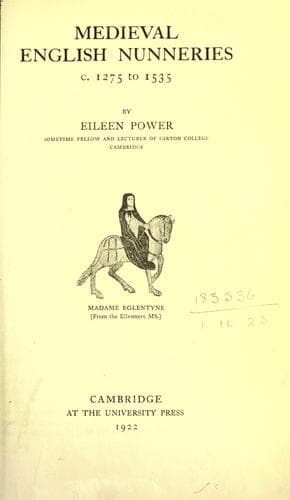
Medieval English Nunneries c. 1275 to 1535Power, Eileen
History
Medieval English Nunneries c. 1275 to 1535
Power, Eileen
Convents -- England; Monastic and religious life of women -- History
(3) _Issues of the manor._ Before passing on to sources of income of a
more specifically ecclesiastical character, some account must be given of
the third great class of receipts which came to a convent in its capacity
of landowner, to wit the "issues of the manor." Attached to almost every
nunnery was its home farm, which provided the nuns with the greater part
of their food[301]. A large nunnery would thus reserve for its own use
several manors and granges, but usually other manors in its possession
would be farmed by bailiffs, who sold the produce at market and paid in
the profits to the treasuress or to one of the obedientiaries; or else a
manor would be leased to a tenant. The surplus produce of the home farm,
which could not be used by the nuns, was also sold. The treasuress usually
entered the receipts and expenditure of the home farm in her household
account and she had to keep two sets of records, the one a careful account
of all the animals and agricultural produce on the farm, with details as
to the use made of them; and the other (under the heading of "issues of
the manor") a money record of the sums obtained from sales of live stock,
wool or grain. An analysis of the produce of the home farm of Catesby
(1414-5)[302] shows that the chief crops grown were wheat and barley. Of
these a certain proportion was kept for seed to sow the new crops; almost
all the rest of the wheat was paid in food allowances to the servants and
1 qr. 3 bushels in alms "to friars of the four orders and other poor";
most of the barley was malted, except 6 qrs. delivered to the swineherd to
feed hogs; and what remained was stored in the granaries of the convent.
Oats and peas were also grown and part of the crop used for seed, part for
food-allowances to the servants and oatmeal for the nuns. The Prioress
also kept a most meticulous account of the livestock on her farm. All were
numbered and classified, cart-horses, brood-mares, colts, foals, oxen,
bulls, cows, stirks (three-year old), two-year old, yearlings, calves,
sheep, wethers, hogerells, lambs, hogs, boars, sows, hilts, hogsters and
pigs. In each class it was carefully set down how many animals remained in
stock at the end of the year and what had been done with the others. We
know something of the consumption of meat by the nuns of Catesby and their
servants in this year of grace 1414-5, when the old rule against the
eating of meat was relaxed; and we see something of the cares of a
medieval housewife in those days before root-crops were known, when the
number of animals which could be kept alive during the winter was strictly
limited by the amount of hay produced on the valuable meadow land. Only in
summer could the convent have fresh meat; and on St Martin's day (Nov. 11)
the business of killing and salting the rest of the stock for winter food
began[303]. From good Dame Elizabeth Swynford's account it appears that
five oxen, one stirk, thirty hogs and one boar were delivered to the
Public-domain text, read in full here on John Shaqi.
Reviews
Reviews
No reviews yet
Be the first to share your thoughts on this work.
Elsewhere in the archive
Join the Discussion
Join the discussion
Sign in to leave a comment or review.
Sign InorCreate an account