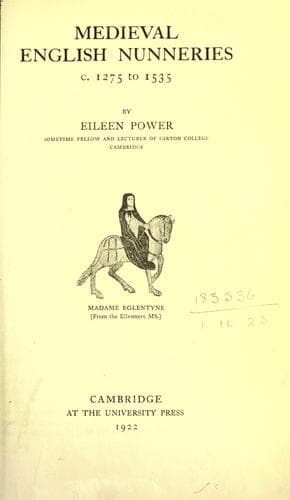
Medieval English Nunneries c. 1275 to 1535Power, Eileen
History
Medieval English Nunneries c. 1275 to 1535
Power, Eileen
Convents -- England; Monastic and religious life of women -- History
Such were the chief sources from which a medieval nunnery derived its
income. We must now consider the chief expenses which the nuns had to meet
out of that income. It has already been shown that the total income of a
nunnery was paid into the hands of the treasuress or treasuresses, save
when the office of treasuress was filled by the head of the house, or when
a male _custos_ was appointed by the bishop to undertake the business. It
has also been shown that the treasuress paid out certain sums to the chief
obedientiaries (notably to the cellaress), to whose use certain sources of
income were indeed sometimes earmarked, and that these obedientiaries
kept their separate accounts. The majority of nunnery accounts which have
survived are, however, treasuresses' accounts; that is to say they
represent the general balance sheet at the end of the year, including all
the chief items of income and expenditure. The different houses adopt, as
is natural, different methods of classifying their expenses[327]. The
great abbey of Romsey classifies thus: (1) _The Convent_, including sums
for clothing, for the kitchen expenses and for pittances, amounting in all
to L105. 17_s._ 10_d._ (2) _The Abbess_, who kept her separate household
in state; this includes provisions for herself and for her household and
divers of their expenses, a sum of L8. 12_s._ in gifts, a sum in liveries
for the household and spices for the guest-house and a sum in servants'
wages, amounting to L108. 17_s._ in all. (3) _Divers outside expenses_,
including repairs of houses belonging to the Romsey mills, a sum for legal
pleas, another for annuities to the convent and to the king's clerks, who
had stalls in the abbey, over L40 in royal taxes and L1. 14_s._ 8_d._ in
procurations, amounting to L108 in all. (4) _Miscellaneous expenses_
include L8. 19_s._ 4_d._ in alms to the poor, L6. 13_s._ 4_d._ in wine for
nobles visiting the abbess, a sum for mending broken crockery, a sum for
shoeing the horses of the Abbess' household, and in horse-hire and
expenses of men riding on her business, 14_s._ in oblations of the Abbess
and her household and L10 in gift to Henry Bishop of Winchester on his
return from the Holy Land. (5) _Repairs_ and other expenses at six manors
belonging to this wealthy house, amounting to L77. 2_s._ 6-1/2_d._ The
total expenses of the abbey this year (1412) came to L431. 18_s._ 8_d._,
against a revenue of L404. 6_s._ 1_d._, drawn from six manors and
including rents, the commutation fees for villein services, the sale of
wool, corn and other stores and the perquisites of the courts. The deficit
is characteristic of nunneries[328].
Public-domain text, read in full here on John Shaqi.
Reviews
Reviews
No reviews yet
Be the first to share your thoughts on this work.
Elsewhere in the archive
Join the Discussion
Join the discussion
Sign in to leave a comment or review.
Sign InorCreate an account