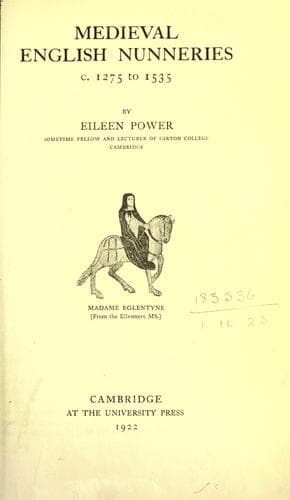
Medieval English Nunneries c. 1275 to 1535Power, Eileen
History
Medieval English Nunneries c. 1275 to 1535
Power, Eileen
Convents -- England; Monastic and religious life of women -- History
An interesting picture of many sides of monastic life is given by a
general analysis of the chief classes of expenditure usually mentioned in
account rolls. They may be classified as follows: (1) internal expenses of
the convent, (2) divers miscellaneous expenses connected with external
business, (3) repairs, (4) the expenses of the home farm and (5) the
wage-sheet.
(1) _The internal expenses of the convent._ The details of this
expenditure are sometimes not given very fully, because they were set
forth at length in the accounts of the cellaress and chambress; but a
certain amount of food and of household goods and clothes was bought
directly by the treasuress and occasionally the office of cellaress and
treasuress was doubled by the same nun, whose account gives more detail.
Expenditure on clothing appears in one of two forms, either as
dress-allowances paid annually to the nuns[329], or as payments for the
purchase of linen and cloth and for the hiring of work-people to spin and
weave and make up the clothes[330]. Expenditure on food is usually
concerned with the purchase of fish and of spices, the only important
foods which could not be produced by the home farm.
Among other internal expenses are the costs of the guest-house and the
alms, in money and in kind, which were given to the poor. Account rolls
sometimes throw a side light on the fare provided for visitors: for
instance the treasuress of St Radegund's, Cambridge, enters upon her roll
in 1449-50 the following items under the heading _Providencia Hospicii_:
And paid to William Rogger, for beef, pork, mutton and veal bought for
the guest house, by the hand of John Grauntyer, 24_s._ 8_d._ And for
bread, beer, beef, pork, mutton, veal, sucking pigs, capons, chickens,
eggs, butter and fresh and salt fish, bought from day to day for the
guest house during the period of the account, as appears more fully
set out in detail, in a paper book examined for this account, L11.
7_s._ 4-1/2_d._ And for one cow bought of Thomas Carrawey for the
guest house vj s viij d. Total: L13. 8_s._ 8-1/2_d._[331]
In this year the total receipts were L77. 8_s._ 6-1/2_d._ and the
expenditure L72. 6_s._ 4-3/4_d._, so that quite a large proportion of the
nuns' income was spent on hospitality. On the other hand the food was no
doubt partly consumed by these "divers noble persons," who paid the
convent L8. 14_s._ 4_d._ this year for their board and lodging. It is a
great pity that the separate guest-house account book referred to has not
survived. At St Michael's Stamford the roll for 15-16 Richard II contains
a payment of 26_s._ 10_d._ "for the expenses of guests for the whole
year," and 6_s._ 8_d._ "for wine for the guests throughout the year"[332];
this is a very small amount out of a total expenditure of L116. 15_s._
4-1/2_d._ and it seems likely that the greater part of the food used for
guests was not accounted for apart from the convent food.
Public-domain text, read in full here on John Shaqi.
Reviews
Reviews
No reviews yet
Be the first to share your thoughts on this work.
Elsewhere in the archive
Join the Discussion
Join the discussion
Sign in to leave a comment or review.
Sign InorCreate an account