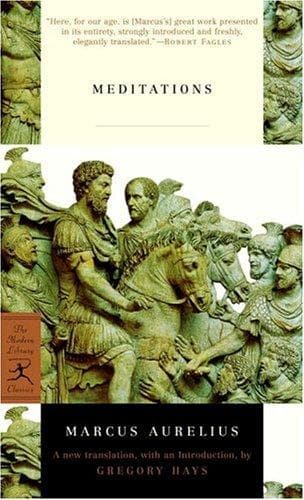
MEDITATIONS
By Marcus Aurelius
CONTENTS
NOTES
INTRODUCTION
FIRST BOOK
SECOND BOOK
THIRD BOOK
FOURTH BOOK
FIFTH BOOK
SIXTH BOOK
SEVENTH BOOK
EIGHTH BOOK
NINTH BOOK
TENTH BOOK
ELEVENTH BOOK
TWELFTH BOOK
APPENDIX
GLOSSARY
INTRODUCTION
MARCUS AURELIUS ANTONINUS was born on April 26, A.D. 121. His real name
was M. Annius Verus, and he was sprung of a noble family which claimed
descent from Numa, second King of Rome. Thus the most religious of
emperors came of the blood of the most pious of early kings. His father,
Annius Verus, had held high office in Rome, and his grandfather, of
the same name, had been thrice Consul. Both his parents died young, but
Marcus held them in loving remembrance. On his father's death Marcus
was adopted by his grandfather, the consular Annius Verus, and there was
deep love between these two. On the very first page of his book Marcus
gratefully declares how of his grandfather he had learned to be gentle
and meek, and to refrain from all anger and passion. The Emperor Hadrian
divined the fine character of the lad, whom he used to call not Verus
but Verissimus, more Truthful than his own name. He advanced Marcus to
equestrian rank when six years of age, and at the age of eight made him
a member of the ancient Salian priesthood. The boy's aunt, Annia Galeria
Faustina, was married to Antoninus Pius, afterwards emperor. Hence it
came about that Antoninus, having no son, adopted Marcus, changing his
name to that which he is known by, and betrothed him to his daughter
Faustina. His education was conducted with all care. The ablest teachers
were engaged for him, and he was trained in the strict doctrine of the
Stoic philosophy, which was his great delight. He was taught to dress
plainly and to live simply, to avoid all softness and luxury. His body
was trained to hardihood by wrestling, hunting, and outdoor games; and
though his constitution was weak, he showed great personal courage to
encounter the fiercest boars. At the same time he was kept from the
extravagancies of his day. The great excitement in Rome was the strife
of the Factions, as they were called, in the circus. The racing drivers
used to adopt one of four colours--red, blue, white, or green--and their
partisans showed an eagerness in supporting them which nothing could
surpass. Riot and corruption went in the train of the racing chariots;
and from all these things Marcus held severely aloof.
In 140 Marcus was raised to the consulship, and in 145 his betrothal
was consummated by marriage. Two years later Faustina brought him a
daughter; and soon after the tribunate and other imperial honours were
conferred upon him.
Public-domain text, read in full here on John Shaqi.
Reviews
Reviews
No reviews yet
Be the first to share your thoughts on this work.
Join the Discussion
Join the discussion
Sign in to leave a comment or review.
Sign InorCreate an account