[Transcriber's note: This production is based on
https://archive.org/details/meditationsmoral00guiz/page/n3]
{1}
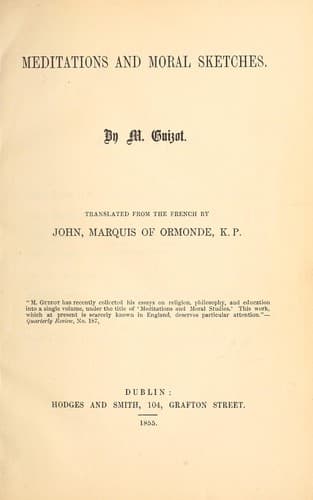
Meditations And Moral Sketches.
_By M. Guizot._
Translated From The French By
John, Marquis Of Ormonde, K. P.
"M. Guizot has recently collected his essays on religion,
philosophy, and education into a single volume, under the title
of 'Meditations and Moral Studies.' This work, which at present
is scarcely known in England, deserves particular
attention."--_Quarterly Review_, No. 187,
Dublin:
Hodges And Smith, 104, Grafton Street.
1855.
{2}
Dublin:
Printed By R. D. Webb,
Gt. Brunswick-St.
{3}
_Translator's Preface._
The three following Essays, although written some time back,
appear to bear so strongly on a question daily and hourly
discussed among ourselves, that I make but one apology for
presenting them in an English form, which is to the illustrious
author, whose sentiments (notwithstanding all the attention I
have given to the task) I cannot but fear I may yet have failed
in representing.
{4}
The Translation contained in the following pages originated in
the simple desire to facilitate the access to sentiments deemed
beneficial.
He who undertook this pleasing and benevolent task, has been
removed from this earthly scene. Let it be hoped that this solemn
truth may add interest to his labours for others, and that his
earnest wishes for their benefit may be in some measure realized.
{5}
Preface.
When I collected these moral sketches, which were written at
different times and under varying circumstances, I did not think
that I needed to add anything to them. A recent event, however,
has determined me, in now publishing them, to say a few words
more.
Having been called upon on the 30th of last April to take the
chair at a meeting of the Protestant Bible Society, I expressed
myself in these terms:--
What is after all, speaking religiously, the great question,
the most important question which at present occupies the
minds of men? It is the question in debate between those who
acknowledge and those who deny a supernatural, certain, and
sovereign order of things, although inscrutable to human
reason. The question in dispute, to call things by their right
names, between supernaturalism and naturalism. On the one
side, unbelievers, pantheists, pure rationalists, and sceptics
of all kinds. On the other, Christians.
"Amongst the first, the best still allow to the statue of the
Deity, if I may make use of such an expression, a place in the
world and in the human soul; but to the statue only,--an image,
a marble. God himself is no longer there. Christians alone
possess the living God.
{6}
Public-domain text, read in full here on John Shaqi.
Reviews
Reviews
No reviews yet
Be the first to share your thoughts on this work.
Join the Discussion
Join the discussion
Sign in to leave a comment or review.
Sign InorCreate an account