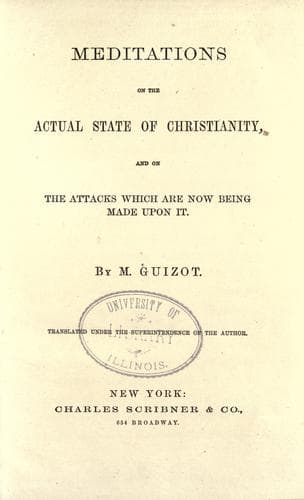
Meditations on the Actual State of Christianity, and on the Attacks Which Are Now Being Made Upon It.Guizot, François
Religion
Meditations on the Actual State of Christianity, and on the Attacks Which Are Now Being Made Upon It.
Guizot, François
Christianity; Philosophy and religion; Religious thought -- 19th century
In holding this language in his very first work, the Abbé de la
Mennais was already forgetting that he was a Christian and a
Catholic. When a man demands here below an infallible authority,
he must not seek it from any human source. The reason of all?
(That is, the reason of the majority of men in all the ages of
the world, for the reason of _all_ is a fallacy.) What is
such reason, but the sovereignty of superior numbers in the
spiritual order? Having fixed his principle, the Abbé de la
Mennais kept it in sight everywhere. After having established an
infallible authority in the name of the reason of all, he
proclaimed the absolute sovereignty in the name of universal
suffrage.
{28}
But this apostle of universal reason was at the same time the
proudest worshiper of his own reason. Under the pressure of
events without, and of an ardent controversy, a transformation
took place in him, marked at once by its logical deductions and
its moral inconsistency: he changed his camp without changing his
principles; in the attempt to lead the supreme authority of his
Church to admit his principles he had failed; and from that
instant the very spirit of revolt that he had so severely rebuked
broke loose in his soul and in his writings, finding expression
at one time in an indignation full of hatred leveled at the
powerful, the rich, and the fortunate ones of the world; at
another time in a tender sympathy for the miseries of humanity.
The "Words of a Believer" are the eloquent outburst of this
tumult in his soul. Plunged in the chaos of sentiments the most
contradictory, and yet claiming to be always consistent with
himself, the champion of authority became in the State the most
baited of democrats, and in the Church the haughtiest of rebels.
{29}
It is not without sorrow that I thus express my unreserved
opinion of a man of superior talent--mind lofty, soul intense; a
man in the sequel profoundly sad himself, although haughty in his
very fall. One cannot read in their stormy succession the
numerous writings of the Abbé de la Mennais without recognizing
in them traces, I will not say of his intellectual
perplexities--his pride did not feel them--but of the sufferings
of his soul, whether for good or for evil. A noble nature, but
full of exaggeration in his opinions, of fanatical arrogance, and
of angry asperity in his polemics. One title to our gratitude
remains to the Abbé de la Mennais--he thundered to purpose
against the gross and vulgar forgetfulness of the great moral
interests of humanity. His essay on indifference in religious
questions inflicted a rude blow upon that vice of the time, and
recalled men's souls to regions above.
{30}
And thus it was that he, too, rendered service to the great
movement and awakening of Christians in the nineteenth century,
and that he merits his place in that movement although he
deserted it. [Footnote 5]
[Footnote 5: The principal works of the Abbé de la Mennais
are:
Public-domain text, read in full here on John Shaqi.
Reviews
Reviews
No reviews yet
Be the first to share your thoughts on this work.
Join the Discussion
Join the discussion
Sign in to leave a comment or review.
Sign InorCreate an account