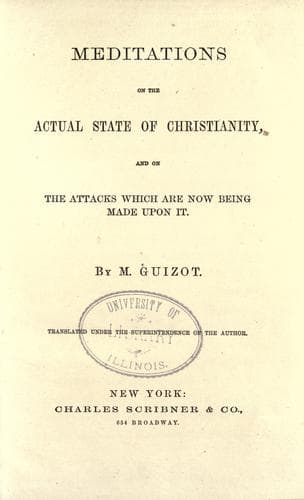
Meditations on the Actual State of Christianity, and on the Attacks Which Are Now Being Made Upon It.Guizot, François
Religion
Meditations on the Actual State of Christianity, and on the Attacks Which Are Now Being Made Upon It.
Guizot, François
Christianity; Philosophy and religion; Religious thought -- 19th century
[Footnote 43: Mélanges d'histoire religieuse. Pp. 250-254.
1864.]
{255}
"That which is really imperiled is not so much Protestantism;
it is Christianity, it is very religion. As for natural
religion, that exists only in books. Religions which have vital
force and influence are positive religions; that is, religions
which have a Church, and particular rites, and dogmas. What are
these dogmas? Taken in their intimate meaning, they are the
solutions of the great problems which have ever disquieted the
mind of man--the origin of the world, and of evil; the
expiation; the future of humanity. The doctrines of religion
are a sort of revealed metaphysics.
"Considered in its form, dogma is the supernatural--not merely
because religions were born at an epoch when the imagination
was greedy of miracles, and when the imagination, in her
_näiveté_, associated herself with everything; but also
because, as may be readily understood, it is impossible for a
positive religion to have any other origin than a revelation;
it is necessarily a history of the intervention of God in the
destinies of man, the account of acts by which God created and
saved the world--it is that or it is nothing. We see then at
once that in religion everything is not religious. There is in
every religion a multitude of elements, historical, physical,
and metaphysical, as to which its dogmas may come into conflict
with science. Nevertheless, it is not of this antagonism that I
would here speak. The religious sentiment has also its critical
action; _it_ also may enter into a struggle with religion.
{256}
"As long as the authority of the priest or of the book
preserves its prestige, the believer receives his religion
ready made for him, without himself making distinctions; but as
soon as that authority is shaken, a man, if he do not entirely
reject his first belief, will at least no longer accept it
without reservations. He only retains so much of it as
enlightens or touches him, so much as commends itself to his
understanding or to his heart; so much, in a word, as gives a
satisfaction to his religious requirements.
Public-domain text, read in full here on John Shaqi.
Reviews
Reviews
No reviews yet
Be the first to share your thoughts on this work.
Elsewhere in the archive
Join the Discussion
Join the discussion
Sign in to leave a comment or review.
Sign InorCreate an account