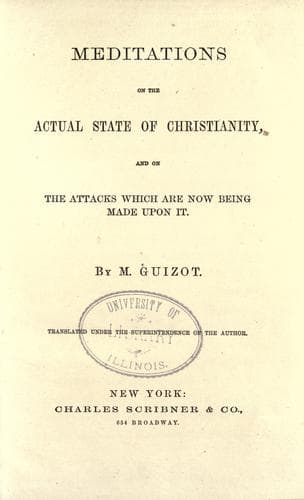
Meditations on the Actual State of Christianity, and on the Attacks Which Are Now Being Made Upon It.Guizot, François
Religion
Meditations on the Actual State of Christianity, and on the Attacks Which Are Now Being Made Upon It.
Guizot, François
Christianity; Philosophy and religion; Religious thought -- 19th century
"Utility is perhaps the highest motive to which reason can
attain. ... It is from the moral or religious faculty alone
that we obtain the conception of the purely disinterested. ...
The substitution of the philosophical conception of truth for
its own sake, for the theological conception of the guilt of
error, has been in this respect a clear gain; and the political
movement which has resulted chiefly from the introduction of
the spirit of Rationalism into politics, has produced, and is
producing, some of the most splendid instances of
self-sacrifice. On the whole, however, the general tendency of
these influences is unfavorable to enthusiasm, and both in
actions and in speculations this tendency is painfully visible.
With a far higher level of average excellence than in former
times, our age exhibits a marked decline in the spirit of
self-sacrifice, in the appreciation of the more poetical or
religious aspect of our nature. The history of self-sacrifice
during the last eighteen hundred years has been mainly the
history of the action of Christianity upon the world.
{253}
Ignorance and error have, no doubt, often directed the heroic
spirit into wrong channels, and have sometimes even made it a
cause of great evil to mankind; but it is the moral type and
beauty, the enlarged conception and persuasive power of the
Christian faith, that have chiefly called it into being, and it
is by their influence alone that it can be permanently
sustained. ...
"This is the shadow resting upon the otherwise brilliant
picture the history of Rationalism presents. The destruction of
the belief in witchcraft and of religious persecutions; the
decay of those ghastly notions concerning future punishments,
which for centuries diseased the imaginations and embittered
the character of mankind; the emancipation of suffering
nationalities; the abolition of the belief in the guilt of
error, which paralyzed the intellectual, and of the asceticism
which paralyzed the material progress of mankind, may be justly
regarded as among the greatest triumphs of civilization; but
when we look back to the cheerful alacrity with which, in some
former ages, men sacrificed all their material and intellectual
interests to what they believed to be right, and when we
realize the unclouded assurance that was their reward, it is
impossible to deny that we have lost something in our
progress." [Footnote 42]
[Footnote 42: History of the Rise and Influence of the Spirit
of Rationalism in Europe, by W. E. H. Lecky, vol. ii, 1866,
third edition, pp. 403-409.]
{254}
But to leave England and Mr. Lecky, and to return once more to
France. I turn to the pages of a rationalistic philosopher more
profound, and more profoundly troubled, too, in his sentiments
than Mr. Lecky. I find there, in an essay of M. Edmond Scherer,
entitled "The Crisis of Protestantism," [Footnote 43] the
following passage:
Public-domain text, read in full here on John Shaqi.
Reviews
Reviews
No reviews yet
Be the first to share your thoughts on this work.
Elsewhere in the archive
Join the Discussion
Join the discussion
Sign in to leave a comment or review.
Sign InorCreate an account