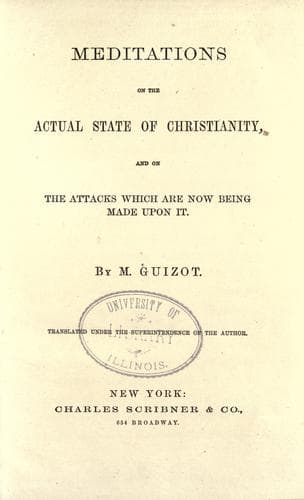
Meditations on the Actual State of Christianity, and on the Attacks Which Are Now Being Made Upon It.Guizot, François
Religion
Meditations on the Actual State of Christianity, and on the Attacks Which Are Now Being Made Upon It.
Guizot, François
Christianity; Philosophy and religion; Religious thought -- 19th century
The famous "enthymême" of Descartes, "I think, therefore I am,"
is a pleonasm. As soon as the human being says to itself "I," the
human being affirms its own existence, and distinguishes itself
from that external world whence it derives impressions of which
it is not the author.
{292}
In this primary fact are revealed the two primary objects of
human knowledge: on the one side the human being himself, the
individual person that feels and perceives, that feels himself
and perceives himself; on the other side, the external world that
is felt and perceived: the subject and the object, (the
_moi_ and the _non-moi_.) Such is the twofold field, at
the beginning of his intellectual existence, opened to the
knowing faculty of man.
In each of these fields, whether the human being makes himself or
whether he makes the external world the object of his
contemplation, he proceeds by the same method; he considers
particular facts, classes these under more general facts which
serve as their summary, and recognizes laws that govern them,
these laws being themselves facts. When this method of
observation and of generalization is applied to the outer world,
understanding by that world the human body also, it gives birth
to the sciences of physics and of physiology.
{293}
When such method is applied to the human being, regarded as
distinct from the body in which he lives and by which he acts, it
gives birth to the science of psychology, logic, and morals. It
is not here my intention to propose a classification of the
sciences, but only to determine the domain of science properly so
called--that is to say, the field in which the human mind by
observation gets directly at facts and at the laws of facts.
Philosophers, in their study of man and of the world, do not
sufficiently consult language, the general language, the common
language, that instinctive expression of the activity of the
human mind. I interrogate our native language upon the question
which now occupies me, and I find it reflecting the greatest
light. It has, to express the results of the intellectual process
which takes place in man, when regarded as the spectator of the
universe and of himself, many different words: "connaître,"
"savoir," "croire," "connaissance," "science," "croyance," "foi."
{294}
These are not mere different names to express the same idea and
the same fact, they are signs of different facts and of diverse
states of the human soul. If we interrogate the languages of
civilized nations, ancient or modern, we find in all of them,
with more or less abundance, precision or subtlety, a similar
variety of terms corresponding to a similar diversity of facts.
Public-domain text, read in full here on John Shaqi.
Reviews
Reviews
No reviews yet
Be the first to share your thoughts on this work.
Elsewhere in the archive
Join the Discussion
Join the discussion
Sign in to leave a comment or review.
Sign InorCreate an account