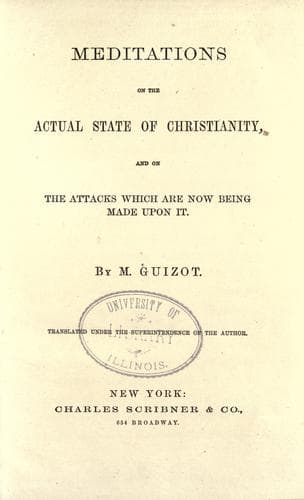
Meditations on the Actual State of Christianity, and on the Attacks Which Are Now Being Made Upon It.Guizot, François
Religion
Meditations on the Actual State of Christianity, and on the Attacks Which Are Now Being Made Upon It.
Guizot, François
Christianity; Philosophy and religion; Religious thought -- 19th century
Talleyrand said once in the chamber of Peers, "There is somebody
who has more intellect than Napoleon, more intellect than
Voltaire; that somebody is the Public." I also say, there is a
more profound observer than Bacon, a greater philosopher than
Kant; it is mankind. Mankind is right when it distinguishes in
its languages knowledge from science and from belief, science
from belief and from faith. Bossuet wrote a book entitled "De la
Connaissance de Dieu et de soi-même;" the idea would never have
occurred to him of entitling it "De la science de Dieu et de
soi-même;" it would have shocked his good sense as much as his
piety.
{295}
The child believes the smile and the speech of its mother; in its
belief there is certainly no scientific appreciation (no science)
of the relations which unite it to its mother, and of the reasons
which make it believe in her. Knowledge, science, belief, and
faith, are facts essentially distinct, although all equally
natural to the human soul; and it is impossible to confound them,
to take one for the other, to annul one in favor of the other, or
to attempt to reduce them to one term, without ignoring
realities, and falling into enormous errors.
Such has been the constant error of M. Auguste Comte, and such is
the radical vice of Positivism. M. Comte ignores the natural and
permanent diversity in the intellectual states through which a
man may pass in his ardent pursuit of truth. He refuses here to
recognize any state as legitimate and definitive except the
scientific state. He regards intuitive knowledge and instinctive
belief as preparatory and transitory states, states without any
rational authority; as, in short, simple steps on the way to that
scientific state which alone sets man in possession of the truth.
{296}
Positivism is thus led to extend the pretensions of science
beyond its proper domain, that is, beyond the finite world, its
facts and its laws; and as science finds itself incapable of
observing and of defining infinity, Positivism is, perforce,
reduced either to deny infinity, or to declare infinity
absolutely inaccessible to the human mind, and so to pass it over
in silence.
Public-domain text, read in full here on John Shaqi.
Reviews
Reviews
No reviews yet
Be the first to share your thoughts on this work.
Elsewhere in the archive
Join the Discussion
Join the discussion
Sign in to leave a comment or review.
Sign InorCreate an account