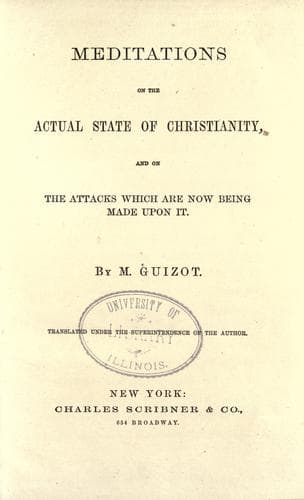
Meditations on the Actual State of Christianity, and on the Attacks Which Are Now Being Made Upon It.Guizot, François
Religion
Meditations on the Actual State of Christianity, and on the Attacks Which Are Now Being Made Upon It.
Guizot, François
Christianity; Philosophy and religion; Religious thought -- 19th century
The moral instincts, and the naturally lofty mind of M. Comte
revolted at this consequence, although it flowed imperiously from
his system. The respect which he felt for the method of
observation, and for the facts which it attains to, did not
permit him absolutely to ignore or expressly to deny the
psychological fact of man's liberty. Sometimes he attempts to
find it a place in that sum of external facts and fixed laws
which is, in his opinion, the sole field for man's activity and
for man's science.
{299}
But such is the want of coherence of idea, that M. Comte is
visibly embarrassed; consequently, in his works--more especially
in his "Cours de philosophie positive,"--the most solid and
consistent of all his writings in its fundamental principles--he
sets almost completely aside the essential fact of human liberty,
and of free will in the individual man; and in those books in
which he treats of social organization, when he finds himself
face to face with the wants and the rights of political liberty,
that natural consequence of individual free will and of the
responsibility attaching to it, he struggles to elude questions
of this kind, feeling the impossibility of reconciling the
principle of moral order with the despotism and the fatalism of
the material world; and when he explains his views as to the
government of human societies, it is easy to see that, although
writing "I am, head and heart Republican," [Footnote 60] he is,
in his dreams, rather substituting a scientific domination for a
theocratic domination than instituting any liberal _régime_.
[Footnote 60: Auguste Comte et la phil. pos., by M. Littré,
p. 251.]
{300}
After metaphysics comes history. M. Comte appeals to the annals
of all nations and all ages in confirmation of his system of the
world and of humanity. This history is to be divided, according
to him, into three successive states, the theological state, the
metaphysical state, and the scientific state. In the theological
state and epoch, the human mind and social institutions are under
the empire of pretended supernatural powers, of several such or
of only one such, invented by man for the solution of the natural
problems which lay siege to man, and for the determination of the
laws, with which the social order cannot dispense. In the
metaphysical epoch and state, vain abstractions essay to replace
the supernatural powers of the theological state, and only end in
an anarchy, both of opinions and society. The third epoch is
destined to be the reign of positive science, founded solely upon
observation and respect for the facts, the forces, and the laws
of that external world which is the theater of man's existence.
The first two states are, according to him, essentially
irrational and transitory. They are the first steps of that which
M. Comte styles the grand evolution of humanity, of which the
_régime_ of science is the end and the summit.
{301}
Public-domain text, read in full here on John Shaqi.
Reviews
Reviews
No reviews yet
Be the first to share your thoughts on this work.
Elsewhere in the archive
Join the Discussion
Join the discussion
Sign in to leave a comment or review.
Sign InorCreate an account