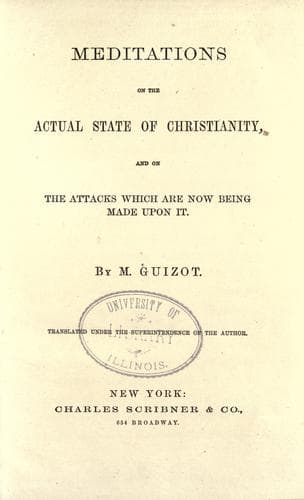
Meditations on the Actual State of Christianity, and on the Attacks Which Are Now Being Made Upon It.Guizot, François
Religion
Meditations on the Actual State of Christianity, and on the Attacks Which Are Now Being Made Upon It.
Guizot, François
Christianity; Philosophy and religion; Religious thought -- 19th century
It would be difficult more entirely to deform, difficult to show
greater ignorance of man's general history. That which M. Comte
regards as three successive states in the history of the human
race is only the complex and permanent condition of humanity,
agitated by movements swaying in different directions, according
as it meets with the successes or encounters the reverses, the
hopes, or the fears to which different nations and generations
are subject. That theological conceptions and metaphysical
meditations are only transitory facts, "which," according to the
expression of M. Comte, "will have henceforth only an historical
existence," is an assertion no more true of such facts than of
those that the study of physics supplies. These different
yearnings of the mind, and their different labors, are the very
essence--the indestructible and indivisible essence--of human
nature.
{302}
At no time and in no country have men more ceased, or will they
more cease, to pray to God, and to strive to comprehend him, than
they will cease to study the physical world, and to make it
subserve their interests. Nations and generations of individuals,
in different ages, have advanced more or less in one or other of
these careers of intellectual activity; and so they will continue
to advance. Religious faith, metaphysical meditation, and
scientific inquiry have their alternations of enthusiasm and of
languor, of glory and of sterility; they appear and they prosper,
sometimes separately, sometimes simultaneously. If India plunged
herself deep among the symbols of mythology and amid the void of
Pantheism, Greece cultivated with like success the metaphysical
and the natural sciences--Aristotle was the contemporary of
Plato. Where other nations fluctuated variously between
theological conceptions, metaphysical abstractions, and
scientific studies, the Hebrew people continued, in the
theological state, Monotheists.
{303}
In the sixteenth century, when the spirit of free inquiry and of
independence was awakened, and made its influence felt far and
wide, Christian faith, at the same time, was resuscitated and
confirmed; and the eighteenth century founded at once the
political liberty of Protestant England and the philosophical and
literary glory of Catholic France. The human mind has, according
to time and place, its favorite labors and its favorite impulses;
but it subsists always one and entire; it never renounces any one
of its grand hopes or of its grand operations; and those men
strangely mutilate and debase it who represent the mind as
having, during ages, lost itself in the vain effort to attain a
knowledge of God and of its own nature, and who condemn it
henceforth to take up its quarters in the science of matter--of
its forces--of its laws.
{304}
Public-domain text, read in full here on John Shaqi.
Reviews
Reviews
No reviews yet
Be the first to share your thoughts on this work.
Elsewhere in the archive
Join the Discussion
Join the discussion
Sign in to leave a comment or review.
Sign InorCreate an account