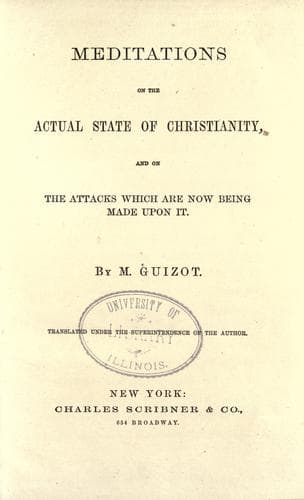
Meditations on the Actual State of Christianity, and on the Attacks Which Are Now Being Made Upon It.Guizot, François
Religion
Meditations on the Actual State of Christianity, and on the Attacks Which Are Now Being Made Upon It.
Guizot, François
Christianity; Philosophy and religion; Religious thought -- 19th century
When Authority has had a long dominion, and its abuse too has
been long, a reaction occurs: Liberty has her revenge; but in her
turn is prone to compromise her interests by abuses and by
excess. It is the history of all human society; facts prove it
quite as much as common sense foretells it. In the bosom of this
general fact it is the peculiar character, as it is the glory, of
Christianity that it has fully accepted these two rival forces;
and the one in the face of the other--authority and
liberty--both of divine origin.
{33}
Christianity has constantly accounted them for such as they
are--the one the revealed law of God, the other the innate right of
man, whom God created free and responsible. The history of the
Jews is only that of the intimate and continued relations between
God as sovereign and man as free agent; God uttering and giving
the law, man using his liberty at one time to fulfill, at another
to reject, the law of God. When the great day of humanity dawned
and Jesus came, it was in liberty's name, and in claiming the
right of the soul to obey the divine law according to its
convictions, that Christianity engaged in its primitive struggle
of three centuries. Under this banner, too, it conquered, and
under it religious society and civil society combined without
becoming identical. The tempestuous and painful fecundity of the
middle ages succeeded to the tyrannical unity of the Roman
empire, so sterile in result.
{34}
Hence principles the most inconsistent, issues the most
contradictory--the power of religion and the power of the
state--popes and kings now supporting, now combating each other's
ambitious purposes, and thwarting each other's measures, without
any regard to law or right; liberty sometimes suffering cruelly
by their alliance, sometimes happily profiting by their
dissensions; on some occasions popes, on others monarchs
protecting liberty against their reciprocal pretensions and
excesses. Spiritual and temporal princes still wavered in their
maxims and in their policy, and did not during the middle ages
systematically and on all occasions form coalitions, of which
liberty was to pay the cost. Liberty, on the contrary, continued
to subsist and to grow in the midst of their rivalries and of her
own sufferings. But these rivalries and these sufferings produced
a chaos which recurred incessantly, and became ever more and more
intolerable, precisely on account of the progress still made, and
which no effort could stifle.
{35}
The great body of Christians at last demanded some issue from
this chaos; then those who wielded the religious power and the
civil power, now separately, now in concert, endeavored to
satisfy the craving of the world; and by their councils,
pragmatic sanctions, encyclical letters and concordats, sought to
reform the abuses and the grievances which, as men loudly
proclaimed, existed, if not in the Church itself, at least in the
relations of the Church with the State. Whether from want of
Public-domain text, read in full here on John Shaqi.
Reviews
Reviews
No reviews yet
Be the first to share your thoughts on this work.
Join the Discussion
Join the discussion
Sign in to leave a comment or review.
Sign InorCreate an account