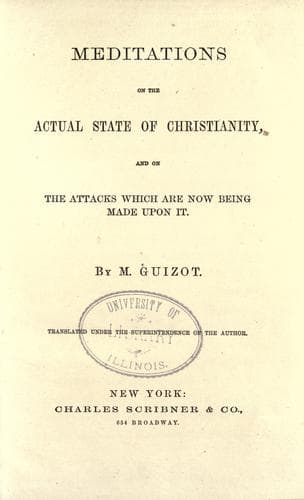
Meditations on the Actual State of Christianity, and on the Attacks Which Are Now Being Made Upon It.Guizot, François
Religion
Meditations on the Actual State of Christianity, and on the Attacks Which Are Now Being Made Upon It.
Guizot, François
Christianity; Philosophy and religion; Religious thought -- 19th century
And some years after holding this language, and while still in
the plenitude of bodily vigor and thought, M. Comte in his turn
launched into a theological career; he took it upon him to
transform Positivism into a religion. By the most violent of all
personified abstractions, he made out of humanity the great
being, the real being, sovereign and adorable, and he placed that
being in the place of God, declaring himself at the same time to
be his chief priest.
{306}
He had more than once proclaimed that all religion was
essentially founded upon the supernatural; and yet a religion all
natural--the religion of humanity, the worship of humanity, the
church of humanity, were summoned by him to succeed to the
Christian religion and to the Church of Christ. On the 19th of
October, 1851, when terminating his third philosophical course on
the general histories of humanity, M. Comte summed it up in these
words: "In the name of the past and of the future, the
theoretical servitors and the practical servitors of humanity are
about to assume worthily the direction of the general affairs of
this world, in order to construct, at last, the true providence,
moral, intellectual, and material, at the same time excluding
irrevocably from political supremacy all the different slaves of
God--Catholics, Protestants, or Deists--as being at once in
arrear of the age and its perturbators." The positivist religion
thus proclaimed, a positivist catechism and a positivist
calendar--these last both composed by M. Comte--reduced his
principles to practice.
{307}
In a series of conversations between "The Priest and the Woman,"
the catechism first establishes and explains the dogma, then the
worship, of the new religion, its internal order and its external
order, its private worship and its public worship. And the
calendar, by a retrospective chronology, determines for any given
year of thirteen months, and for the seven days of the week, the
names of the grand servitors in every department of humanity, who
are to replace the Christian saints: three hundred and sixty-four
names, men and women, with one hundred and sixty-five additional
names, are inscribed upon this list, which begins with Moses and
ends with Bichat, passing through Homer, Aristotle, Archimedes,
Cæsar, Saint Paul, Charlemagne, Dante, Gutenburg, Shakspeare,
Descartes, and Frederic the Second!
Public-domain text, read in full here on John Shaqi.
Reviews
Reviews
No reviews yet
Be the first to share your thoughts on this work.
Elsewhere in the archive
Join the Discussion
Join the discussion
Sign in to leave a comment or review.
Sign InorCreate an account