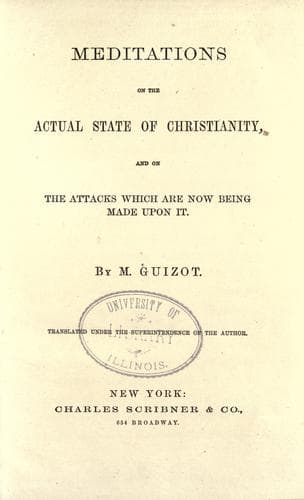
Meditations on the Actual State of Christianity, and on the Attacks Which Are Now Being Made Upon It.Guizot, François
Religion
Meditations on the Actual State of Christianity, and on the Attacks Which Are Now Being Made Upon It.
Guizot, François
Christianity; Philosophy and religion; Religious thought -- 19th century
A chaos is a sorry sight; a chaos of the soul a still sorrier
spectacle than a chaos of worlds! Epochs of moral and social
crises, even while they bring on and prepare for mankind eras of
mighty progress, throw also great and potent intellects into
chaos.
{308}
Under the seduction of a noble ambition, and the delusion of a
partial success, they enthusiastically attach themselves to some
special subject, some incomplete idea; vain of their shallow and
confused systems, or rather of the brilliant coloring in which
they invest them, they pretend to explain and regulate man and
the world, and yet are nothing more than their superficial and
presumptuous observers. Among these "great lost ones of
humanity," (I borrow a phrase of their own,) M. Comte was one of
the most disinterested and the most sincere. The sincerity and
the courage evinced by him in expressing his convictions led him
on from inconsequence to inconsequence; in his benighted course
he caught glimpses occasionally of grand ideas, and of these he
apprehended neither the scope nor the connection: first it was an
idea of a science excluding all idea of religion; and then a
certain idea of a religion reconciled with and intimately united
with the idea of science; turn by turn he gave himself up to the
one and to the other with a blind and a daring devotedness.
{309}
Had he appeared in Greece at the great era of philosophy, or in
France in the seventeenth century, in the midst of the great
Christian controversy, he would have been taxed with insanity--at
the one epoch, not only by Plato but by Aristotle; at the other,
not only by Bossuet but by Spinoza. In our days he has been more
fortunate: he attached himself passionately to the method of
observation of facts, which is the very character of science, and
although his observations were superficial, inexact, and
incomplete--although he fell into the strangest
inconsistencies--the fundamental principle of his system, and the
coincidence of his primary ideas with the method and the tendency
of the physical sciences, the darling study of our age, have
given him more importance and more influence than were really his
due.
-------------------------------
{310}
Fifth Meditation.
Pantheism.
No two essays at philosophy are more dissimilar--I should indeed
say more contradictory--than Pantheism and Positivism. What
Positivism declares to be impossible, Pantheism seeks to
accomplish; what Positivism forbids man to seek, Pantheism
promises to give him. It is the fundamental principle of
Positivism to confine the human mind to the finite world, its
facts and its laws; Pantheism aspires at a knowledge and a
comprehension of Infinity, and of the relations of the finite
with Infinity. "I have explained God, God's nature and his
attributes," says Spinoza. [Footnote 62]
[Footnote 62: Ethics, 1st part; of God: Appendix, vol. i, p.
39. French translation by M. Saisset.]
{311}
Public-domain text, read in full here on John Shaqi.
Reviews
Reviews
No reviews yet
Be the first to share your thoughts on this work.
Elsewhere in the archive
Join the Discussion
Join the discussion
Sign in to leave a comment or review.
Sign InorCreate an account