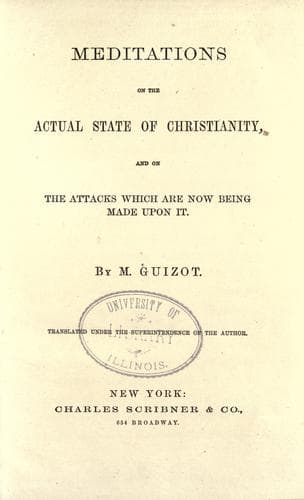
Meditations on the Actual State of Christianity, and on the Attacks Which Are Now Being Made Upon It.Guizot, François
Religion
Meditations on the Actual State of Christianity, and on the Attacks Which Are Now Being Made Upon It.
Guizot, François
Christianity; Philosophy and religion; Religious thought -- 19th century
What obliviousness of man's nature and of man's life! Man is not
merely a being that thinks, but a being that feels, wills, and
acts, a being moral and responsible for his acts, at the same
time that he is a being of intelligence, and a being insatiate of
knowledge. It is by his thought that he accounts to himself for
his sentiments, and for the motives of his acts, but it is not
from his thought that he derives either his sentiments or his
liberty, neither does knowledge constitute his sole enjoyment.
Spinoza mutilates man strangely when he places "the highest
degree of human felicity in the highest degree of human
knowledge." Man is more exacting than the philosopher, and it
requires infinitely more to satisfy the most modest human soul
than to satisfy the proudest mind. Infinitely more in respect of
happiness, infinitely less in respect of science! Not that I
would make their intellectual ambition a reproach to
philosophers, even when it leads them astray.
{316}
It is an honor to the human mind that it aspires higher than it
can attain, that it torments itself in the struggle to carry its
science into that invisible world, which it instinctively feels
by anticipation, just as it does into that visible world that it
sees. God granted to man this privilege; he implanted in his soul
the ardent desire to know him and to possess him fully. But at
the same time, God granted to men in general certain instincts
and spontaneous beliefs which adequately satisfy this desire
without the necessity of any profound study. What would have
become of the human race if, in order to believe in God, to hope
in him, and to pray to him, man had been obliged to wait until
philosophers had resolved the problems which still weigh upon
_their_ genius? As God, in creating man free, took care that
the maintenance of the general order in this world should not be
completely abandoned to the disputes of men, so did he provide
for the spiritual nourishment of mankind, without denying to the
great ambitious ones of the earth either the prospect of a
satisfaction more complete, or the right to search for it.
{317}
Let us never tire of repeating, this is the mystery of man's
mixed nature--an indication of a destiny in store for him
superior to his actual condition. He carries within him the ideas
of infinity, of perfection, and yet here below he is nothing but
a finite being, imperfect, equally incapable of sufficing to
himself and of satisfying himself, either in the domain of
thought or of actual life. "There are more things in heaven and
upon earth than philosophy--than even the philosophy 'of the
absolute'--can explain. ... To comprehend God, it needs to be
God. A child might have said as much to Hegel." These words I
borrow from M. Edmond Scherer's exposition of the doctrine of
Hegel. [Footnote 65]
[Footnote 65: Melanges d'histoire religieuse, pp. 366, 341.
1864.]
Public-domain text, read in full here on John Shaqi.
Reviews
Reviews
No reviews yet
Be the first to share your thoughts on this work.
Elsewhere in the archive
Join the Discussion
Join the discussion
Sign in to leave a comment or review.
Sign InorCreate an account