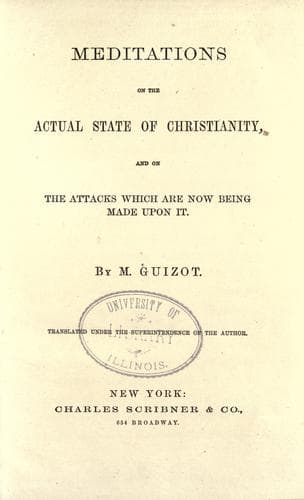
Meditations on the Actual State of Christianity, and on the Attacks Which Are Now Being Made Upon It.Guizot, François
Religion
Meditations on the Actual State of Christianity, and on the Attacks Which Are Now Being Made Upon It.
Guizot, François
Christianity; Philosophy and religion; Religious thought -- 19th century
Jesus in effect said, eighteen centuries ago: "I praise thee,
Father, Lord of heaven and of earth, that thou hast hidden these
things from the wise and prudent, and hast revealed them unto
babes."
{318}
Pantheists are entirely of the opinion of M. Scherer, for to
enable man to comprehend God, they have found no other expedient
than to make of man himself the God that man is desirous of
comprehending. The passion for an universal science has ended by
receiving no being as God but man.
The passion for universal unity has led to the same result. That
truth is one--that is to say, that all truths, whatever their
object, are in harmony with one another--the very word truth
implies and proclaims. From the unity of truth the Pantheists
passed, with a single bound, to the unity of being. They
identified idea and reality, science and existence, confounding
all things in order to reduce them to one single thing, and
abolishing all beings in order to concentrate them all in one and
the same being, which, after all, is nothing more than an
impersonal notion and a barren name, falling in its turn into the
void.
{319}
By what path did the Pantheists arrive at this abyss? What was
the process employed by men of eminent powers of mind to
construct a system so singularly factitious and hypothetical, and
yet pretending, at the same time, to be so necessary and so
rigorously philosophical?
Like some great men of antiquity, (and their number is
considerable,) who sought to explain nature and the physical
world by incomplete and precipitate hypotheses and systems,
invented irrespectively of either facts or their laws, the
Pantheists by similar means proceeded--nay, are proceeding--to
explain man, the universe, and God; the Infinite and the finite.
The method which for three centuries has constituted the glory of
the natural sciences, and made their progress lasting, the exact
study of facts and their relations; that method so long strange
not only to general philosophy but to the special sciences
themselves--I may at once call it by its proper name, the
scientific method--was formerly, and remains still, strange to
the Pantheists; to Spinoza as to Plotinus, to Hegel as to
Spinoza.
{320}
Whether Plotinus plunges into an _ecstacy_ to arrive at and
comprehend God in uniting man to God by the virtue of
contemplation; or Spinoza, defining _substance_, makes it
the principle from which to deduce his theory of the universe and
of its unity; or Hegel, speaking of _idea_ in order to
arrive at the same result as Spinoza, seeks to obtain from his
term _substance_--it is the same defect that appears in the
labors of all these potent intelligences, not only in their
development, but in the very point from which they start; for
observation of facts and of their laws they substitute the
affirmation and the definition of an axiom, and the deduction,
logical, it is true, of its consequences. They disdain and set
aside all study of the realities of the universe, believing
Public-domain text, read in full here on John Shaqi.
Reviews
Reviews
No reviews yet
Be the first to share your thoughts on this work.
Elsewhere in the archive
Join the Discussion
Join the discussion
Sign in to leave a comment or review.
Sign InorCreate an account