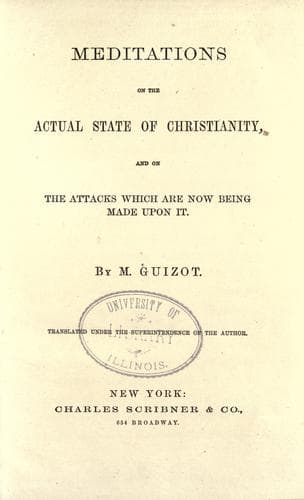
Meditations on the Actual State of Christianity, and on the Attacks Which Are Now Being Made Upon It.Guizot, François
Religion
Meditations on the Actual State of Christianity, and on the Attacks Which Are Now Being Made Upon It.
Guizot, François
Christianity; Philosophy and religion; Religious thought -- 19th century
"It is impossible," says M. Edmond Scherer, "to read Hegel
without asking ourselves if he, be serious. He falls incessantly
into a style of images and personifications; and one would
suppose one's self, in perusing his writings, to be present at
the formation of a mythology, at the development of a world like
that of the ancient Gnostics, in which notions assumed forms and
marched on, passing through all kinds of adventures." [Footnote
69]
[Footnote 69: Melanges d'histoire religieuse, pp. 298, 838.]
M. Edmond Scherer's is a mind hard to please, which is ever
struck and offended by incoherence of objects, futility of
artificial combinations, and vain play upon words, even where he
recognizes or admires the genius. The philosophical "rout" is not
embarrassed for so slight a cause; it marches straight to the
object toward which the dominant idea, once adopted, gives the
impulse. In spite of its complexities and of its craving for the
reconciliation of religion and of politics, the Pantheism of
Hegel has borne its natural fruits.
{327}
A school has resulted from it, which, in accordance with its
proper and independent manifestations, a learned and moderate
judge, M. Willm, characterizes in these words: "The new German
philosophy, of which Feuerbach, Bruno Bauer, and Arnold Rüge are
the principal chiefs, comes, in its ultimate results, in contact
with the _Humanism_ of M. Pierre Leroux, the
_Positivism_ of M. Auguste Comte, and the _Atheism_ of
M. Proudhon. It tends to substitute for the ancient worship the
worship of humanity, and to found a new worship dispensing with
God, and with morality properly so called. ... There is no such
thing as _theology_ but only _anthropology_; for the
mind of humanity is the divine mind realized. There is no longer
any other piety than devotedness to the objects of humanity; no
longer any other prayer than the contemplation of the human mind.
... Man accomplishes every reasonable object if he accomplishes
his own peculiar object, and he cannot do better than employ all
his faculties to realize his own objects. _Man's will be
done:_ such is the principle of the new law." [Footnote 70]
[Footnote 70: Histoire de la philosophie allemande, depuis
Kant jusqu'a Hegel: by S. Willm: vol. iv, pp. 624, 626.]
{328}
Public-domain text, read in full here on John Shaqi.
Reviews
Reviews
No reviews yet
Be the first to share your thoughts on this work.
Elsewhere in the archive
Join the Discussion
Join the discussion
Sign in to leave a comment or review.
Sign InorCreate an account