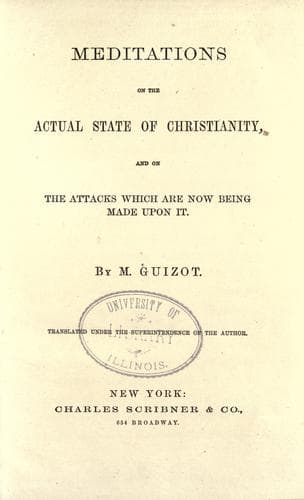
Meditations on the Actual State of Christianity, and on the Attacks Which Are Now Being Made Upon It.Guizot, François
Religion
Meditations on the Actual State of Christianity, and on the Attacks Which Are Now Being Made Upon It.
Guizot, François
Christianity; Philosophy and religion; Religious thought -- 19th century
... "Nothing," adds he, "is bad in itself. Good and evil indicate
nothing positive in things considered in themselves, and are
nothing but manners of thinking. Not only has every man the right
to seek his good, his pleasure, but he cannot do otherwise. ...
The measure of each man's right is his power. ... He who does not
yet know reason, or who, having not as yet contracted the habit
of virtue, lives according to the laws only of his appetites, is
as much in his right as he who regulates his life according to
the laws of reason.
{324}
In other words, just as the sage has an absolute right to do all
that his reason dictates to him, or to live according to the laws
of his reason, in the same manner has the ignorant man and the
madman a right to everything that his appetite impels him to
take; in other words, the right to live according to the laws of
appetite. ... And he is no more obliged to live according to the
laws of good sense than a cat is obliged to live under the laws
that govern the nature of a lion. ... Hence we conclude that a
compact has only a value proportioned to its utility; where the
utility disappears the compact disappears too with it, and loses
all its authority. There is, then, folly in pretending to bind a
man forever to his word; unless, at least, man so contrive that
the breach of the compact shall entail for him that violates it
more danger than profit." [Footnote 67]
[Footnote 67: Œuvres de Spinoza, vol. i, pp. clix, clx.]
{325}
Hegel is less absolute and less blind. Of a mind large, and from
its greatness naturally just, he escaped at moments the yoke of
his system. Struck by the particular truths, moral, historical,
æsthetic, that offered themselves to his view in the theater of
the universe, he admitted them without very well knowing what
place he should assign to them. "He was," said one of his most
intelligent disciples, "a conciliator in his philosophy. His
philosophy stands midway between Theism and Pantheism; between
historical right, as the expression of actual reason, and the
absolute right to liberty and equality, as the end of universal
history. His system seems to sanction the most profound piety,
and to regard Christianity as the true and absolute religion, at
the very time when it appears also as its negation; just as in
politics it presents itself as at one and the same moment
conservative and progressive, favorable to existing rights and
yet revolutionary." [Footnote 68]
[Footnote 68: Histoires de la philosophie allemande depuis
Kant jusqu'a Hegel, by S. Willm: a work crowned by the
Institute: vol. iv, p. 337.]
{326}
Public-domain text, read in full here on John Shaqi.
Reviews
Reviews
No reviews yet
Be the first to share your thoughts on this work.
Elsewhere in the archive
Join the Discussion
Join the discussion
Sign in to leave a comment or review.
Sign InorCreate an account